Heel rise and lower: preserve both forefoot contacts
Describe one small heel lift followed by a return to flat soles. Both front sole regions stay in contact throughout. A two-foot airborne interval would fail this task even if the silhouette resembles a gentle upward rise.
Describe one small heel lift followed by a return to flat soles. Both front sole regions stay in contact throughout. A two-foot airborne interval would fail this task even if the silhouette resembles a gentle upward rise.
Original geometric practice input; untested teaching method. No H3 call or generated result is included.
1. Input and task goal
The original side-view adult faces right. The two shoes have staggered outlines, each with a visible rear heel and front sole. There is space above the head and a clear floor beneath both shoes. The arms hang without touching a prop; the shoe colors identify the same feet through a very small movement.
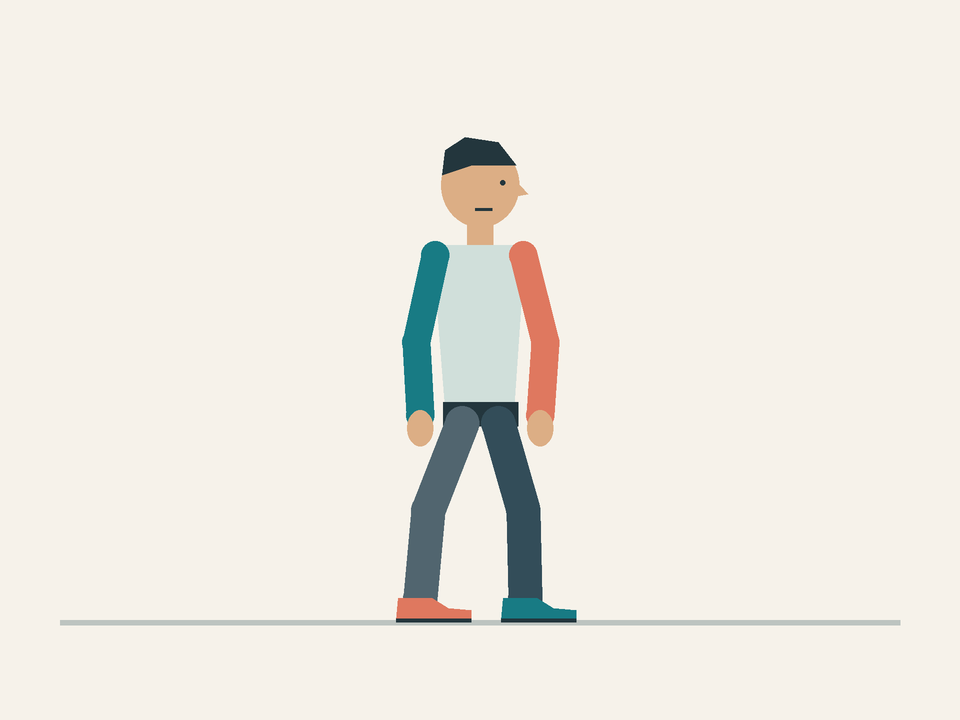
Original authored illustration for reading and comparison; not a generated result.
2. Action phases and fixed relationships
Treat each shoe as two review regions: rear sole and front sole. The front regions remain at the floor while rear regions lift. Ankles and body height can change slightly. Do not ask for the entire shoe to remain fixed while also demanding heel clearance; that would be internally inconsistent.
| Phase | Relationship to inspect |
|---|---|
| 1 | Flat: both rear and front sole regions meet the floor. |
| 2 | Rise: both rear sole regions lift while front contacts remain. |
| 3 | Hold: visible heel gaps coexist with two forefoot contacts. |
| 4 | Lower: heels return once; flat soles settle without a bounce. |
Phases specify order, not exact timing controls. The review diagram is an authored checklist, not output frames or an ending-frame input.
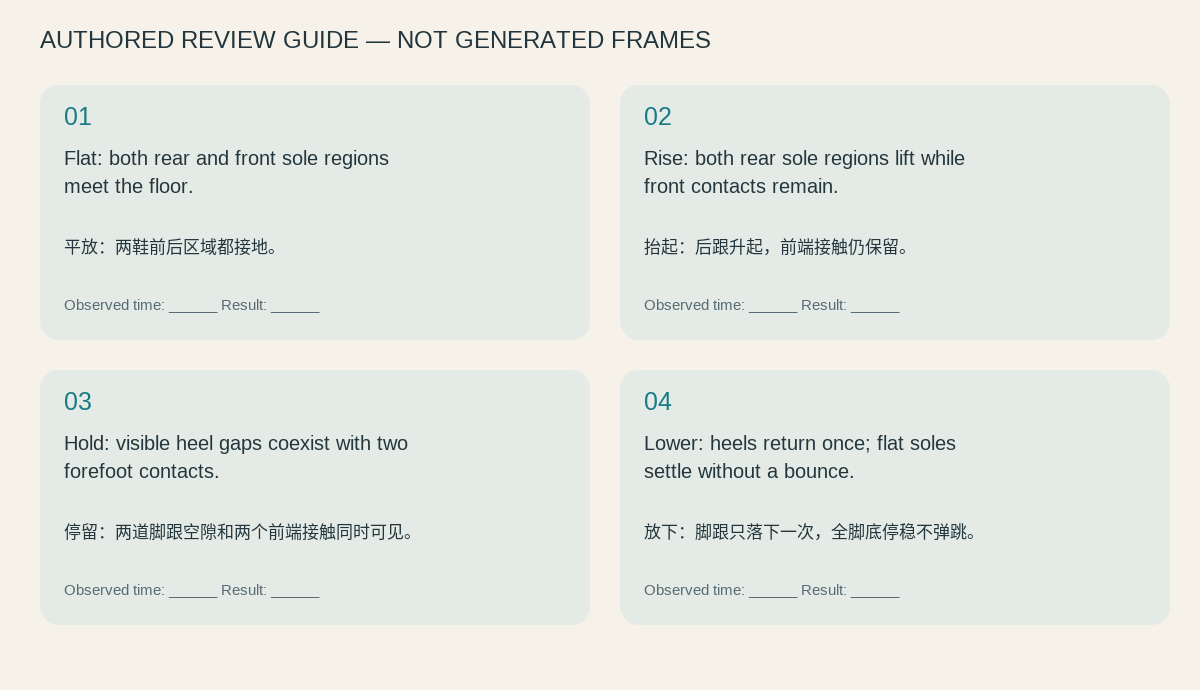
Original authored illustration for reading and comparison; not a generated result.
3. Prepare one manual task
- Inspect the clean source at full size and locate all four sole regions. If one shoe hides the other heel, fix the input before reviewing movement.
- Keep the requested rise small enough that both heel gaps and the head remain visible. Do not add walking, reaching upward or a camera tilt.
- Find the maximum visible heel gap in a future clip and check each front sole independently. One planted forefoot cannot prove that the other stayed down.
- During lowering, watch for the first full-sole contact and the quiet ending. A toe slide or a second bounce should be logged even if the final frame is flat.
Prepare one authorized adult side-view image showing both distinct shoes flat on one visible floor. Keep both heels and forefoot contacts readable, with room above the body for a small heel rise.
Open the image-to-video workspace and select MiniMax H3 base mode if available. If First Frame is hidden and the interface offers Add end frame, enable it to reveal the frame roles. Upload only your prepared authorized image to First Frame, leaving the optional Last Frame empty. Copy the full prompt from this page manually and match its appearance details to your image. Inspect current controls and the actual estimate; stop if the mode or first-frame role is unavailable or a second image is required. The link does not upload an image or insert a prompt. Keep annotated review diagrams out of the input slots.
4. Complete original prompt
The full prompt below describes the page example. For your own image, match appearance, colors and role names to the actual visible source while retaining the action order and review goal. The example is not automatically supplied to the workspace.
Use the original side-view adult drawing with two distinct shoe profiles on a level floor. Keep the camera and floor fixed. Raise both heels gently while the front sole region of each shoe remains touching its original floor location. Allow the ankles and body to rise slightly with the heels, keeping the same limb lengths. Show a small readable gap under each heel and pause. Then lower both heels back to the same floor once and settle with flat soles. No jumping, fully airborne shoe, forward step, sliding toes, knee squat, extra foot, cut or repeated bounce. Keep the entire body and both front and rear shoe regions visible. This is a visual contact distinction, not a strength or balance exercise.
5. Inspect the actual sequence
Fill observations only when real footage exists. Watch the full take, pause around the relevant contact, separation or order change, then replay at normal speed. Timecode, outcome and note cells start empty. Use pass, fail or not-observable; an obscured event is not a pass.
| Check | Actual timecode | Outcome | Notes |
|---|---|---|---|
| Both heels and both front sole regions are visible at the start. | |||
| Each front sole remains touching its initial floor location. | |||
| A gap opens under each heel during the middle phase. | |||
| No phase shows either whole shoe airborne. | |||
| Both heels return without sinking into the floor. | |||
| The body settles once with flat soles and no second rise. |
Use these in-page rows or copy them into your own notes. Enter actual observations only after reviewing a result; use pass, fail or not-observable. Keep the image you actually submitted, complete prompt, selected settings, real task reference and result location with those observations. Hidden or blurred contact remains not-observable.
6. Change one failed variable
- Whole shoes leave the floor → change only the forefoot-contact clause and review both feet.
- Body rises but heels stay flat → explicitly request visible rear-sole gaps; keep body movement modest.
- Toes slide forward → reinforce only the original front-contact locations.
- Return becomes bouncing → clarify only a single lowering and still ending.
7. Retain evidence and task boundaries
Use the in-page checks to observe both heels and both forefoot contacts. Record ambiguous tiny gaps as not-observable. No force, calf strength, balance performance or medical conclusion follows from this drawing.
The hop owner requires both complete soles to leave the ground; this exercise forbids that event. The sit-to-stand owner keeps full soles planted. The face-recognition prompt mentions tiptoeing to a camera inside a narrative but has no separate rear-versus-front sole input or check.
This page contains original text and a program-drawn fictional mannequin, with no real-person material or third-party images. The original geometry may be used and adapted for this project and practice. It does not establish permission for a real likeness or a third-party brand. The text and schematic examples are original authored material.