MiniMax H3 pulley prompt: connect opposite motion at both rope ends
Keep a single supported rope responsible for the relationship between two moving endpoints.
Keep a single supported rope responsible for the relationship between two moving endpoints. A plausible motion of just one block is not enough to show the intended connected system.
Original illustrated practice input; method not independently tested. No H3 generation or model output is supplied. A result, if you later generate one, still needs the checks below.
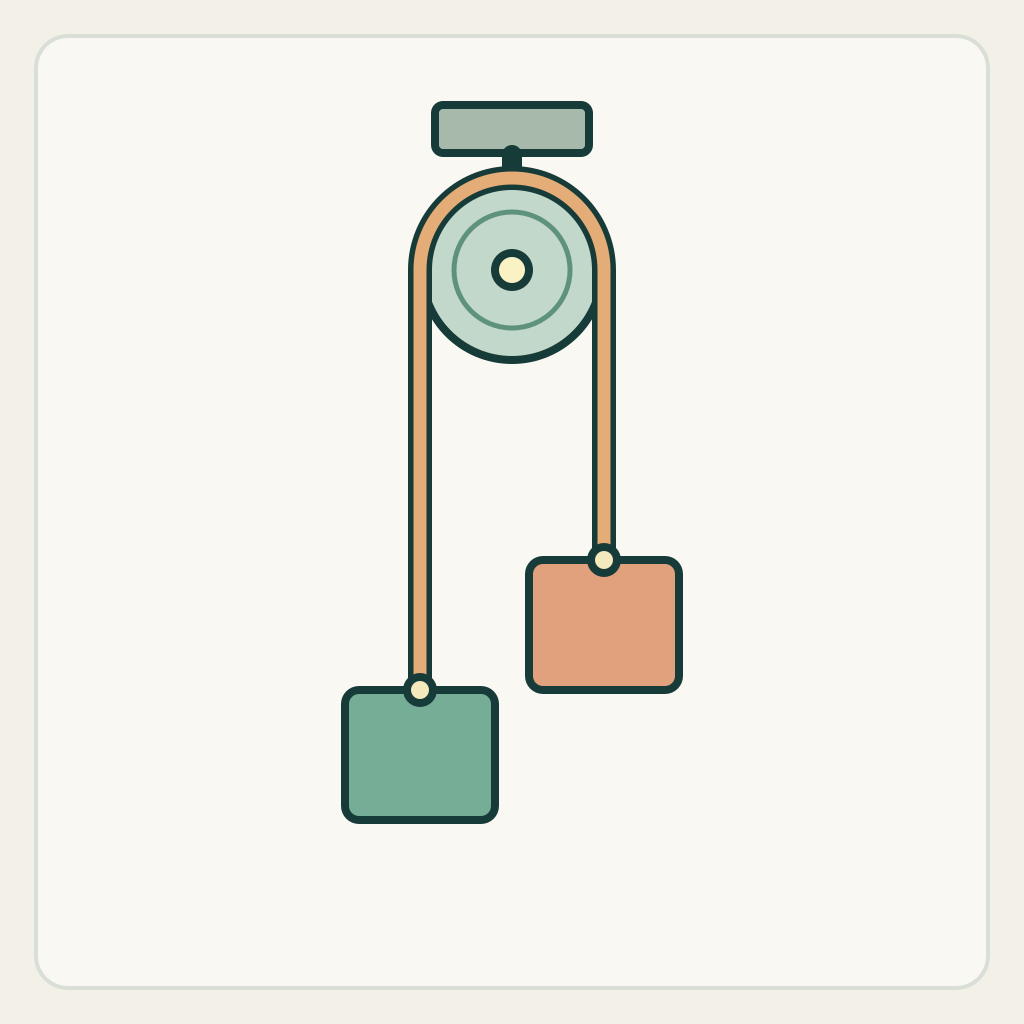
For an actual attempt, prepare a photo or drawing you own or have permission to use. Match the visible starting arrangement, contact gaps, fixed supports and identifying marks described below. Adapt the prompt’s object, color and style names to your image. If a necessary contact or movement space is missing, fix the input before submitting. The on-page illustration is a reading example; you can plan the action without running a generation.
1. Read the starting input
The drawing shows one overhead support, one fixed pulley axle, a continuous rope over the wheel and two attached blank blocks. The left block starts lower than the right. Both rope-to-block attachments are visible and both loads have space to move.
Use the top support and axle as fixed anchors. Trace the rope from the left attachment, over the pulley and down to the right attachment. The left end can descend while the right rises without ever swapping their relative height; a small move does not require a crossover.
2. Set up the current generator
Use MiniMax H3 base image-to-video with your prepared image. If needed, enable Add end frame to expose First Frame, put only that image in First Frame and leave Last Frame empty. Check the actual available settings and current credit estimate before manual submission. The prompt is text you can copy; it does not upload your image or start a task. No exact duration, resolution, endpoint or successful result is guaranteed by these instructions.
3. Copy the original prompt
Begin from your prepared, authorized illustrated first frame. Locked front view. Keep the overhead support and pulley axle fixed. The left hanging block descends a short distance while the right hanging block rises over the same interval. Keep both original blocks attached to the same single continuous rope over the pulley. The rope stays taut and connected; it does not grow an extra loop or detach at either block. Keep the loads visible and stop before either reaches the wheel or the frame edge. The left block remains lower than the right; do not force the two loads to cross or exchange sides. Hold the final connected state. No swing, cut or extra load.
4. Work through one attempt
- Trace the entire visible rope before submitting. A replacement drawing should show actual endpoint connections and enough space above and below both blocks.
- Request one short paired displacement, not a bounce, counterweight calculation or a full cycle. Keep both loads in the same fixed shot so a missing endpoint cannot be hidden.
- In a later result, compare both attachments over the same frames. Record the left-down/right-up relationship and then inspect rope continuity around the upper wheel.
5. Inspect the result
For each criterion below, record the time or frame, visible observation and judgment in your own notes: pass, fail or inconclusive. Fill observed values only after inspecting an actual output; the intended ending is not evidence that the transition occurred.
- The support and pulley axle remain in the same positions.
- The left block descends while the right rises during the same visible interval.
- Both original attachments remain joined by one continuous taut rope, with no extra loop or load.
- The ending retains two visible loads within the frame; a height reversal is neither requested nor required.
6. Change one failure at a time
- If only one end moves, shorten the displacement and explicitly include both endpoints in one shot.
- If the rope length visibly grows or a knot separates, reduce travel and identify the affected attachment rather than adding a second rope.
- If a block starts swinging, remove that side motion from the brief and keep the small vertical relation as the only main action.
7. Ending, limits and related tasks
The same two hanging blocks stop at slightly changed heights, left lower and right higher, still joined through the original fixed pulley.
This is a visible rope-relationship exercise, not a mass-balance calculation, lifting plan, safety demonstration or measured efficiency test. The H3 method is untested.
Use the eyelet exercise for material passing through an aperture. Use this one when both far endpoints must expose the same rope relationship.