Task template
One knee lowers to the floor: inspect the new contact
Plan a single descent from a split stance to a one-knee resting pose. The useful event is the arrival of a new knee-to-floor contact while the forward shoe stays planted. An upright ending or a lower head position alone cannot establish that contact.
MiniMax-H3 · image-to-video · Original task method; generation has not been independently verified.
Start generating video →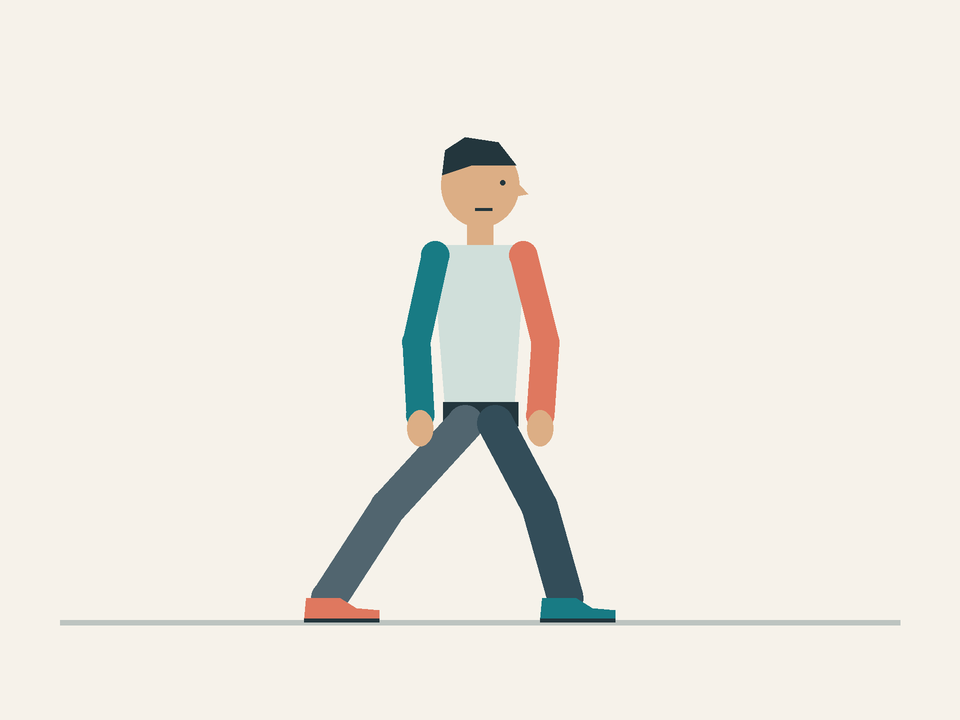
One knee lowers to the floor: inspect the new contact
Plan a single descent from a split stance to a one-knee resting pose. The useful event is the arrival of a new knee-to-floor contact while the forward shoe stays planted. An upright ending or a lower head position alone cannot establish that contact.
Original geometric practice input; untested teaching method. No H3 call or generated result is included.
Input and task goal
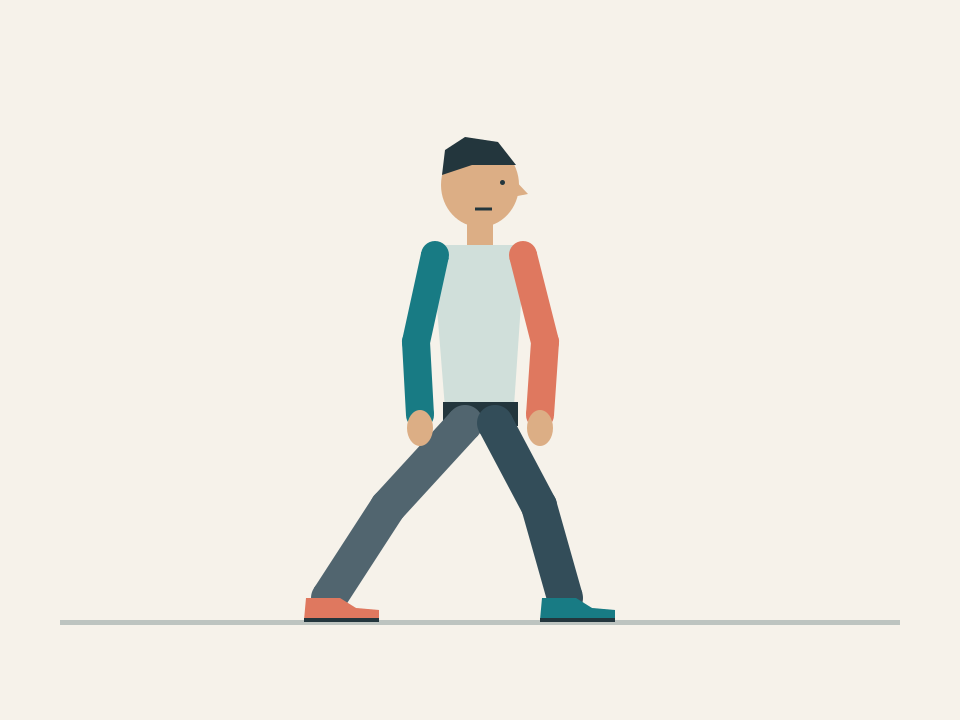
The original side-view mannequin faces picture right. Its teal forward shoe is flat on the floor; its coral rear shoe is farther left, with the rear leg extended behind the hip. Both knees, the empty space below the rear knee, and the floor are visible. The drawing is a fictional adult made from simple geometric shapes, with no chair, pad or support prop. It is a planning input, not an anatomy reference.
PNG · SVG · Complete practice kit
Action phases and fixed relationships
Name the coral rear leg as the descending leg and the teal forward shoe as the planted anchor. The hip may lower and the rear ankle may articulate; freezing every joint would contradict the descent. Keep the floor and camera fixed. The hands remain clear of the floor so a hidden hand support does not replace the requested contact.
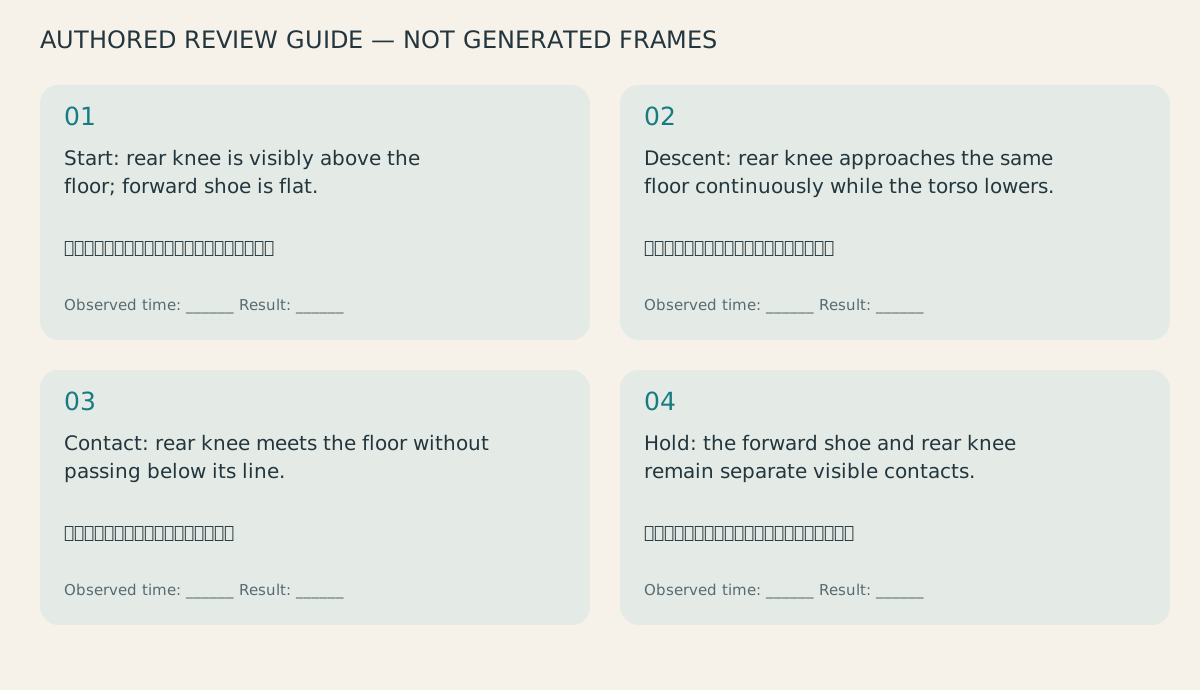
| Phase | Relationship to inspect |
|---|---|
| 1 | Start: rear knee is visibly above the floor; forward shoe is flat. |
| 2 | Descent: rear knee approaches the same floor continuously while the torso lowers. |
| 3 | Contact: rear knee meets the floor without passing below its line. |
| 4 | Hold: the forward shoe and rear knee remain separate visible contacts. |
Phases specify order, not exact timing controls. The review diagram is an authored checklist, not output frames or an ending-frame input.
Prepare one manual task
- Before preparing a draft, trace the rear hip, knee and shoe as one leg. If the two legs overlap in a replacement input, change the composition first; color alone cannot prove which knee reached the ground.
- Use one descent and a hold. Do not append a rise, jump or reach for an object. Keep the forward shoe at its original location, but allow the rear leg to fold.
- In a future result, locate the last visible gap under the rear knee and the first knee contact. Compare the same floor line on either side of the body to detect sinking.
- Replay the ending and follow the front sole as well as the knee. If the contact is hidden behind the forward leg, record not-observable instead of treating a lower silhouette as success.
In the image-to-video workspace, manually choose the MiniMax H3 base mode and place the clean PNG in the first-frame role, leaving the ending frame empty. Check that the current interface supports this combination and inspect its actual estimate; if unavailable, do not submit or put the review diagram into another slot. Downloads do not upload files or start tasks. This exercise assumes no duration, resolution or frame-control guarantee.
Complete original prompt
Use this original side-view fictional-adult drawing. The adult faces picture right, with the teal forward shoe flat on the floor and the coral rear leg extended behind. In one continuous action, bend the legs and lower the coral-side rear knee toward the same floor. Keep the teal forward shoe planted in its original place. Let the rear leg fold coherently as the hip lowers; do not freeze its ankle. Show the rear knee reach the floor once, then hold a quiet one-knee pose with both the new knee contact and the forward sole visible. Keep hands away from the floor, the camera fixed and the floor unchanged. No chair, new support, fall, floor penetration, jump, cut or return to standing. Preserve the same two legs and their connections. This is an untested visual contact request.Inspect the actual sequence
Fill observations only when real footage exists. Watch the full take, pause around the relevant contact, separation or order change, then replay at normal speed. Timecode, outcome and note cells start empty. Use pass, fail or not-observable; an obscured event is not a pass.
- The rear knee starts with a visible floor gap.
- The same rear leg bends continuously; no new knee appears.
- The forward sole stays at its original floor contact.
- The rear knee reaches the floor before the final hold.
- Neither knee nor shoe sinks through the floor.
- One knee and one forward shoe remain readable in the ending; no second descent occurs.
Acceptance CSV / 空白验收表 · Run log / 任务记录
Change one failed variable
- Knee sinks below the line → change only the stop-at-first-contact clause; compare the contact interval again.
- Forward shoe slides back → strengthen only its original-location constraint; keep the descent size unchanged.
- Both knees land → restate only which rear knee descends; do not introduce a prop to mask the other leg.
- The model cuts to a kneeling pose → request an uninterrupted descent; a correct final still does not repair missing motion.
Retain evidence and task boundaries
Keep notes for the last knee gap, first contact and held contact, with actual timecodes only after footage exists. The package supplies no H3 output, successful run, load measurement or exercise technique.
The seated-rise owner removes hip contact from a chair while feet remain planted; this task adds a knee contact without a chair. The small-hop owner requires both soles to leave the floor. The retained warrior prompt starts already kneeling and uses rising plus a fire transformation; it does not document an unobstructed knee-arrival check.
The package contains original text and a program-drawn fictional mannequin, with no real-person material or third-party images. The original geometry may be used and adapted for this project and practice. It does not establish permission for a real likeness or a third-party brand. See the source and rights record.
Related files
- one-knee-descent-floor-contact-README-en-md
- one-knee-descent-floor-contact-README-zh-md
- one-knee-descent-floor-contact-RIGHTS-REVIEW-txt
- one-knee-descent-floor-contact-S01-first-frame-png
- one-knee-descent-floor-contact-S01-first-frame-svg
- one-knee-descent-floor-contact-acceptance-blank-csv
- one-knee-descent-floor-contact-drawing-geometry-json
- one-knee-descent-floor-contact-input-roles-json
- one-knee-descent-floor-contact-package-files-json
- one-knee-descent-floor-contact-practice-kit-zip
- one-knee-descent-floor-contact-prompt-en-txt
- one-knee-descent-floor-contact-prompt-zh-txt
- one-knee-descent-floor-contact-review-guide-svg
- one-knee-descent-floor-contact-run-log-blank-csv
- one-knee-descent-floor-contact-task-definition-json