MiniMax H3 chain prompt: change the bend without breaking link order
Preserve a short articulated object while its neighboring parts change pose.
Preserve a short articulated object while its neighboring parts change pose. A smoother long outline is not enough if the original rigid links fuse, disconnect or pass through one another.
Original illustrated practice input; method not independently tested. No H3 generation or model output is supplied. A result, if you later generate one, still needs the checks below.
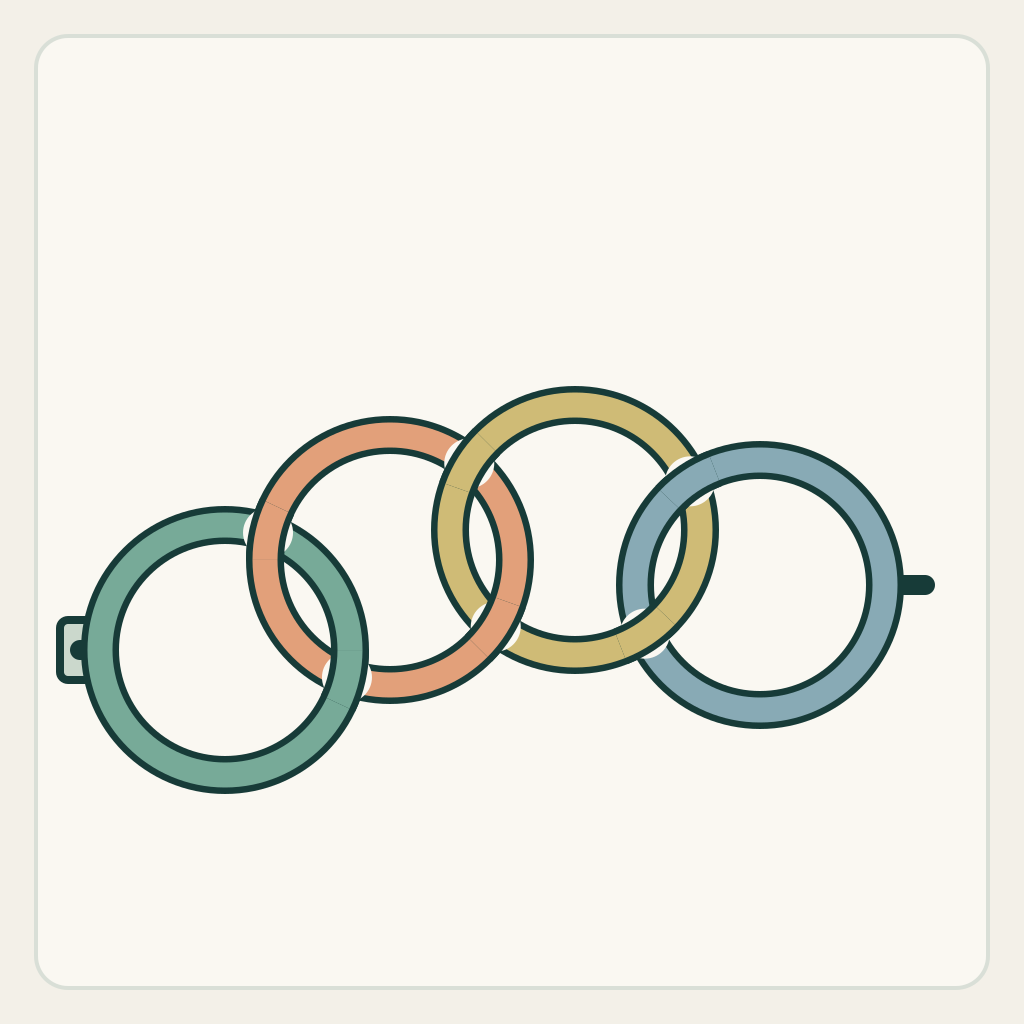
For an actual attempt, prepare a photo or drawing you own or have permission to use. Match the visible starting arrangement, contact gaps, fixed supports and identifying marks described below. Adapt the prompt’s object, color and style names to your image. If a necessary contact or movement space is missing, fix the input before submitting. The on-page illustration is a reading example; you can plan the action without running a generation.
1. Read the starting input
The stylized drawing contains four large round links in a shallow bend. Alternating over-under gaps show the three pairwise interlocks. A small fixed tab holds the left end, and a visible free tab on the right gives the requested movement an endpoint.
Identify four complete conceptual rings and three specific neighboring connections. A short gap drawn at a crossing indicates a hidden segment behind another link, not a broken ring; track which link continues on each side.
2. Set up the current generator
Use MiniMax H3 base image-to-video with your prepared image. If needed, enable Add end frame to expose First Frame, put only that image in First Frame and leave Last Frame empty. Check the actual available settings and current credit estimate before manual submission. The prompt is text you can copy; it does not upload your image or start a task. No exact duration, resolution, endpoint or successful result is guaranteed by these instructions.
3. Copy the original prompt
Use your prepared, authorized four-link chain first frame. Locked camera. Keep the left endpoint tab fixed. Pull the visible right endpoint a small distance away from it toward frame right so the existing shallow bend becomes a little straighter. Retain the same four rigid closed links in the same order, with all three original neighboring interlocks. Each link may turn against its neighbors, but no link stretches, fuses, opens, vanishes or passes through another solid link. Keep the over-under relationships readable at the crossings. Do not add a fifth link or turn the chain into one smooth cord. Stop before a fully taut straight line, then hold the same connected chain. No camera motion or pull-back reveal.
4. Work through one attempt
- Trace each link around its visible and hidden crossing segments in your input. If a replacement input has confusing tangles, simplify it before asking for motion.
- Request a modest endpoint pull and leave some bend. A fully taut pose hides useful connection cues and is not necessary for this exercise.
- For a later result, check each neighboring pair at an intermediate frame as well as at the ending. Counting four colored shapes alone does not establish that their connections survived.
5. Inspect the result
For each criterion below, record the time or frame, visible observation and judgment in your own notes: pass, fail or inconclusive. Fill observed values only after inspecting an actual output; the intended ending is not evidence that the transition occurred.
- The held left tab stays fixed, while the original right endpoint moves only a short distance away.
- Four original separate rigid links remain in the same order.
- All three original neighbor connections remain readable without fusion, an opened ring or solid pass-through.
- The ending is a slightly straighter still-connected chain, not a new cord or a completed tension demonstration.
6. Change one failure at a time
- If the chain becomes a tube, emphasize separate closed links and reduce the amount of endpoint travel.
- If one crossing disconnects, inspect that pair and simplify its source overlap rather than adding more links or motion blur.
- If the system snaps fully straight or leaves the frame, shorten the pull and preserve a visible bend for checking.
7. Ending, limits and related tasks
The same four-link chain stops with less bend, still attached at its held left end and still interlocked through the original three neighbor relationships.
The design and method have no H3 run. They do not measure tension, test metal strength, demonstrate lifting safety or establish exact three-dimensional contact.
Use the eyelet task for a flexible strand through one opening. Use this task when the moving object itself consists of several interlocked rigid parts.