Extend one index finger, then return it to the same fist
Isolate a single-digit change: one index finger uncurls from a loose fist, pauses, and folds back. Keep the thumb and three other fingers in the original closed group. The purpose is distinguishing a selected digit from a whole-hand opening.
Isolate a single-digit change: one index finger uncurls from a loose fist, pauses, and folds back. Keep the thumb and three other fingers in the original closed group. The purpose is distinguishing a selected digit from a whole-hand opening.
Original geometric practice input; untested teaching method. No H3 call or generated result is included.
1. Input and task goal
The original enlarged hand is a loose fist viewed from the palm side. Four rounded knuckle groups run across the top; the thumb lies across the lower front. The index group is the one at picture left nearest the thumb side, not a floating new finger. The cuff and a long forearm are included for connection checks. This is a stylized diagram of a fictional adult hand, not an anatomical specimen.
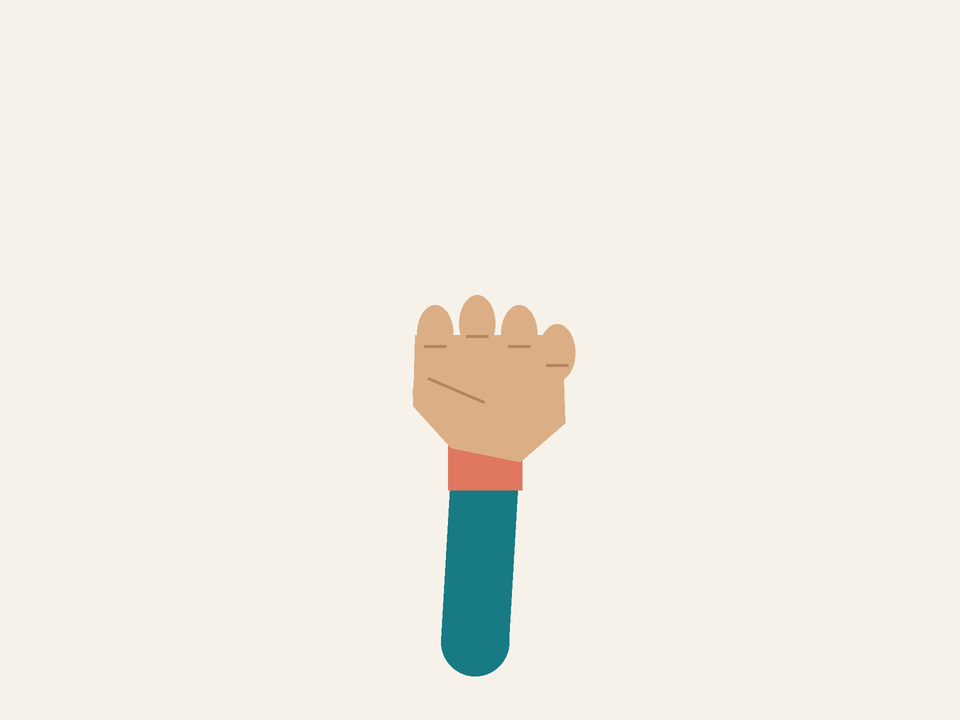
Original authored illustration for reading and comparison; not a generated result.
2. Action phases and fixed relationships
Name the index finger by its starting knuckle beside the thumb. The other three finger groups remain curled, while the thumb stays across the lower front without blocking the index root. Keep the wrist orientation steady. Extending the selected finger must change its folded segments continuously, not grow a straight rod from the top of a closed fist.
| Phase | Relationship to inspect |
|---|---|
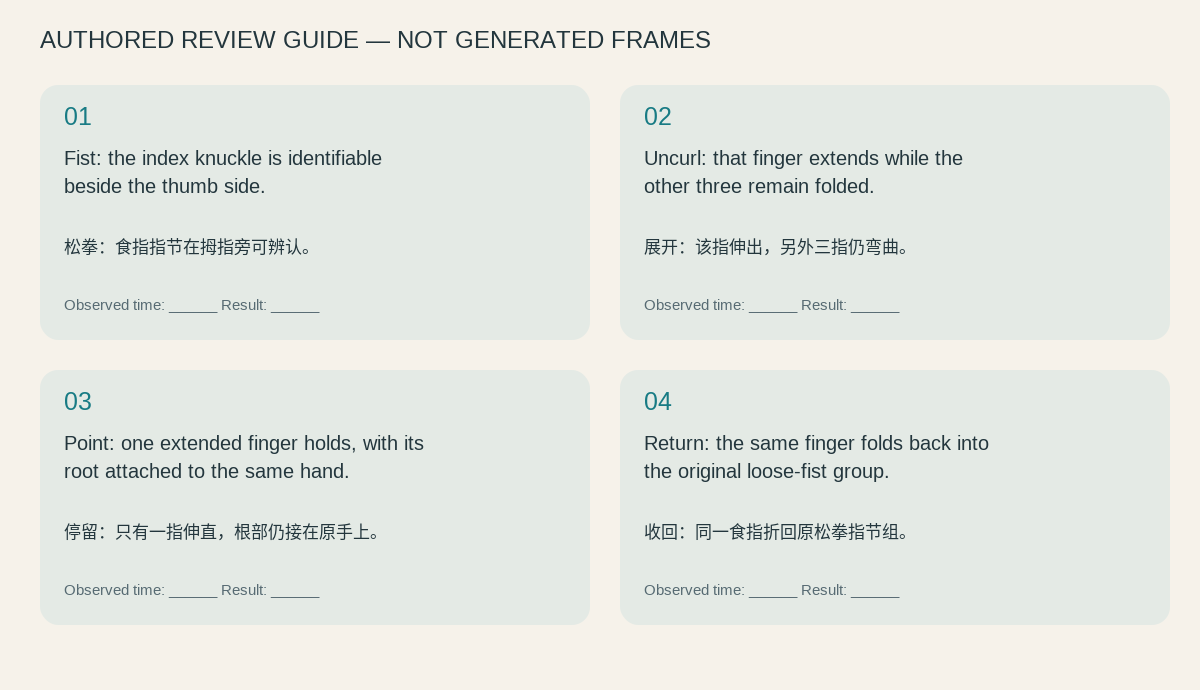
| 1 | Fist: the index knuckle is identifiable beside the thumb side. |
| 2 | Uncurl: that finger extends while the other three remain folded. |
| 3 | Point: one extended finger holds, with its root attached to the same hand. |
| 4 | Return: the same finger folds back into the original loose-fist group. |
Phases specify order, not exact timing controls. The review diagram is an authored checklist, not output frames or an ending-frame input.
Original authored illustration for reading and comparison; not a generated result.
3. Prepare one manual task
- Locate the index root in the input before drafting. If a replacement fist hides it, use a clearer view rather than relying on a finger label alone.
- Use one uncurl and return without pointing at a person or touching anything. No speech, symbolic meaning or signing claim is part of this motion brief.
- When reviewing actual footage, count the non-thumb fingers before, during and after extension. Do not infer correct anatomy from a single raised line.
- Follow the return into the same knuckle group. A finger disappearing into the background or an open palm replacing the fist should be recorded as a failure.
Prepare one authorized close-up of one loose fist with the wrist, thumb and folded-finger group visible. Make the index-finger attachment distinguishable and leave room for that finger to extend without leaving the frame.
Open the image-to-video workspace and select MiniMax H3 base mode if available. If First Frame is hidden and the interface offers Add end frame, enable it to reveal the frame roles. Upload only your prepared authorized image to First Frame, leaving the optional Last Frame empty. Copy the full prompt from this page manually and match its appearance details to your image. Inspect current controls and the actual estimate; stop if the mode or first-frame role is unavailable or a second image is required. The link does not upload an image or insert a prompt. Keep annotated review diagrams out of the input slots.
4. Complete original prompt
The full prompt below describes the page example. For your own image, match appearance, colors and role names to the actual visible source while retaining the action order and review goal. The example is not automatically supplied to the workspace.
Use this original close-up of a loose fist, thumb across the lower front, coral cuff and teal forearm. Keep the camera, wrist angle and forearm steady. The index finger at the picture-left side next to the thumb slowly uncurls from its existing knuckle and extends upward. Keep the other three fingers folded and the thumb across the lower front, leaving the index root readable. Pause with exactly that one finger extended. Then fold the same index finger back into the original loose fist once and stop. Show continuous bending rather than growing or deleting a finger. No full-palm opening, extra digit, second hand, object, touching, pointing target, speech, camera move or cut. The simplified drawing is a planning input, not proof of accurate anatomy.
5. Inspect the actual sequence
Fill observations only when real footage exists. Watch the full take, pause around the relevant contact, separation or order change, then replay at normal speed. Timecode, outcome and note cells start empty. Use pass, fail or not-observable; an obscured event is not a pass.
| Check | Actual timecode | Outcome | Notes |
|---|---|---|---|
| The index starts as part of the original folded hand. | |||
| Only the selected index finger extends. | |||
| Three other non-thumb fingers stay curled without vanishing. | |||
| The thumb remains a separate coherent part of the hand. | |||
| The extended finger connects continuously to its original root. | |||
| The same finger folds back; no duplicate, deletion or full-hand opening occurs. |
Use these in-page rows or copy them into your own notes. Enter actual observations only after reviewing a result; use pass, fail or not-observable. Keep the image you actually submitted, complete prompt, selected settings, real task reference and result location with those observations. Hidden or blurred contact remains not-observable.
6. Change one failed variable
- All fingers open → change only the selected-digit clause, keeping the same source.
- A new finger grows above the fist → emphasize only uncurling from the visible original root.
- Thumb blocks the root → revise the input to reveal that junction before adding motion detail.
- Finger disappears on return → state only folding back into the same knuckle group; inspect the transition.
7. Retain evidence and task boundaries
Record the selected root and the three retained folded groups. No gesture meaning, sign-language translation, motor ability or medical assessment is claimed. The hand geometry remains intentionally simplified.
Object release opens a grip to transfer support; clapping changes contact between two palms. The cosmic-fist prompt closes the entire hand to trigger a transformation. The thunderstorm prompt points a finger during camera moves; this task begins from an inspectable fist and checks single-digit identity across an uncurl-and-return cycle.
This page contains original text and a program-drawn fictional mannequin, with no real-person material or third-party images. The original geometry may be used and adapted for this project and practice. It does not establish permission for a real likeness or a third-party brand. The text and schematic examples are original authored material.