Task template
One object, two hands: support the handoff before releasing
Original two-hand, single-object practice: receiver contact, shared hold and giver release. Includes clean input and blank checks; not independently model tested.
MiniMax-H3 · image-to-video · Original task method; generation has not been independently verified.
Start generating video →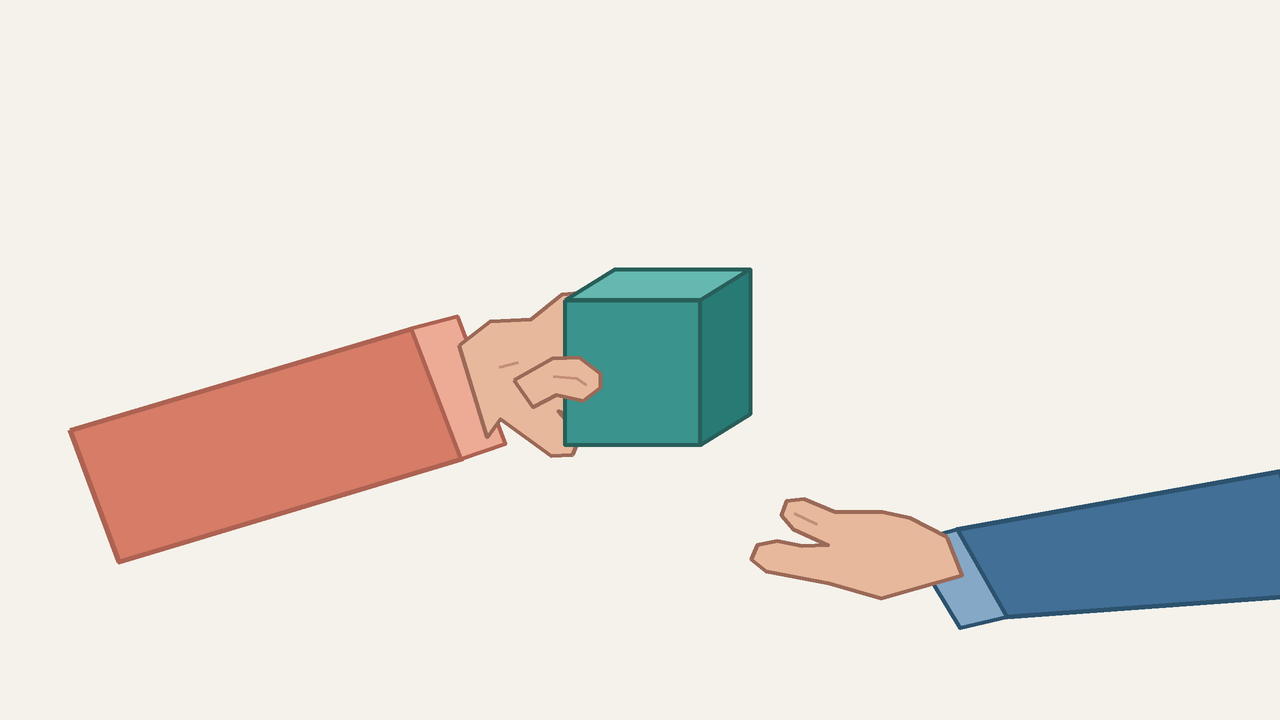
Practice one transfer between two moving hands: the receiver makes contact and establishes a visible hold before the giver opens and withdraws. The same rigid object should finish in the receiver's hand.
Original practice method, not independently tested with MiniMax H3. The images are authored teaching drawings, not video frames from a generated result. No model, physical simulation or video-generation service was run for this package.
Choose the correct input
Open the clean input at full size
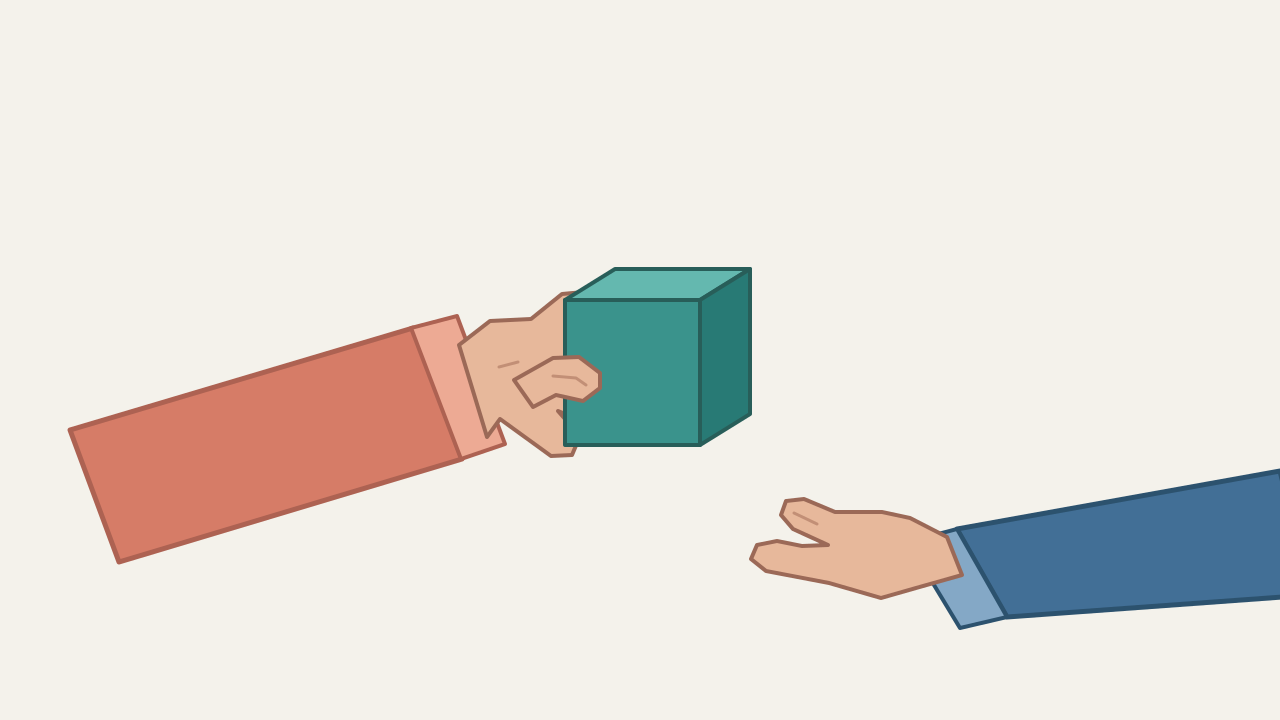
The coral-cuffed hand at frame left is A, the giver. The blue-cuffed hand at frame right is B, the receiver. There is one plain teal cube. These are stylized, original hand drawings with no real-person identity, brand or third-party reference media.
| File | Purpose | Upload? |
|---|---|---|
| clean-start.png | Opening composition with A holding the cube and B visibly separated | Upload this one image |
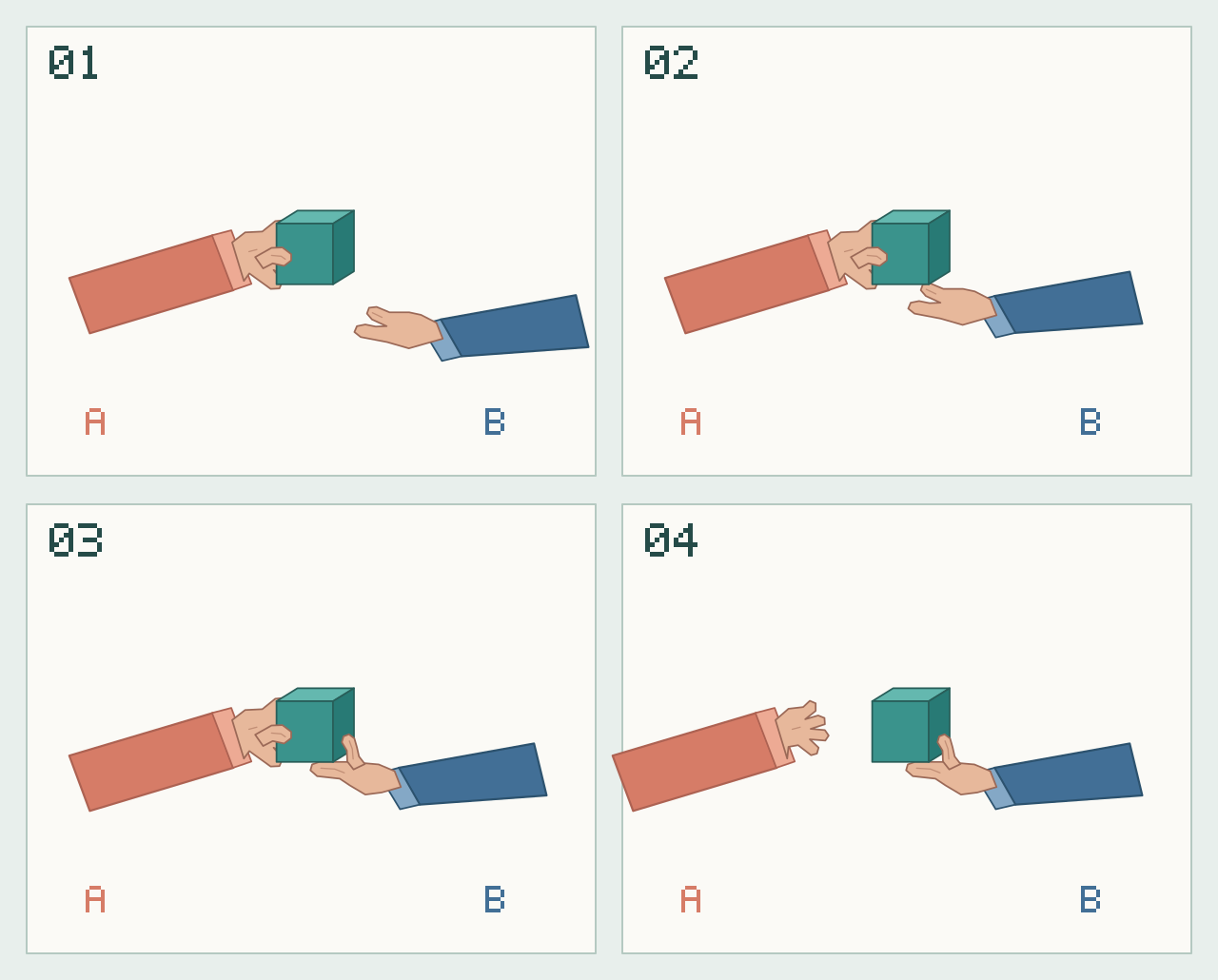
| contact-timeline.png | Numbered teaching drawing for the intended order | No; inspect beside the result |
| acceptance.blank.csv | Blank review sheet with pass, fail or not-observable outcomes | No |
| Editable SVG and complete practice ZIP | Original source drawings, both briefs, prompts and inspection materials | Download for practice/review |
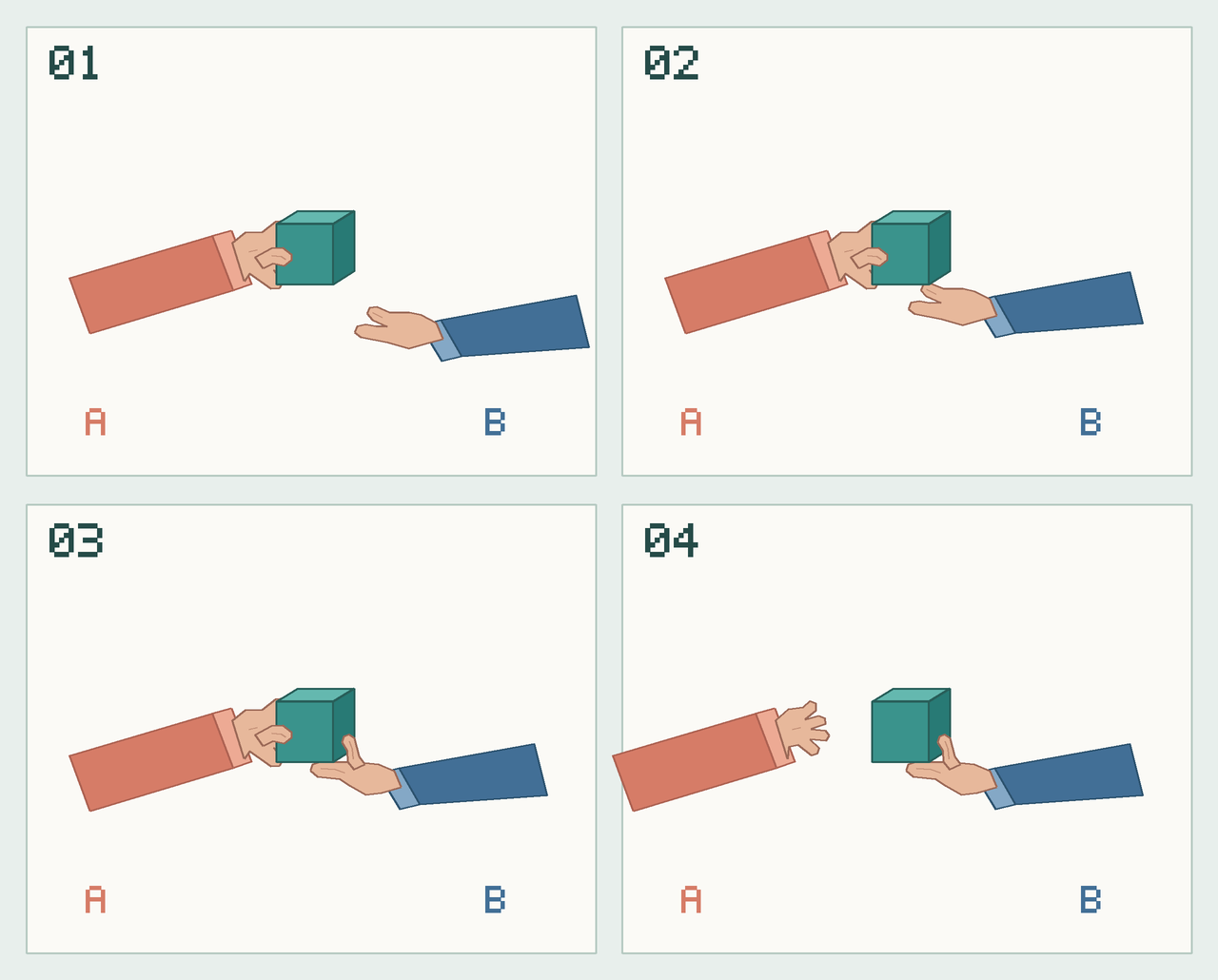
Open the image-to-video generator and select MiniMax H3, the base model rather than MiniMax H3 Fast. Turn on Add end frame to reveal the First Frame and Last Frame slots. Upload only clean-start.png to First Frame and leave Last Frame empty; the base model accepts a first frame without an end frame. Check the currently accepted file type and settings. Opening the generator does not upload a file or start a job. Do not upload the four-panel timeline as a first frame: its repeated cube and hands describe different stages, not four simultaneous objects.
For a replacement, use a permitted image with both hands, the giver's grip, the receiver's open palm and the whole object visible. Start with a simple rigid shape; transparent objects, loose straps and printed labels add unrelated checks.
Separate the four contact states
Open the four-state teaching diagram
| State | What should be visible | What must not happen yet |
|---|---|---|
| 01 — Approach | A holds the cube. B approaches the underside with a clear initial gap. | A must not release during the gap. |
| 02 — Contact | B reaches the cube while A still visibly holds it. | A light touch is not the ending. |
| 03 — Shared hold | B's palm and fingers form a readable supporting hold; A retains contact during this transition. | The cube must not float, duplicate or jump between unrelated grips. |
| 04 — Release and hold | A opens and retreats; B continues holding the same cube. A and cube finish with a visible gap. | Do not perform a second transfer or return to A. |
The numbers express order, not promised timestamps or model controls. The drawing illustrates requested contact states; it does not demonstrate that a model produced them. A visible hold is a reviewable image relationship, not a measurement of weight, grip force or physical stability.
Write one handoff
Keep the camera, background and cube's identity fixed. Change the support relationship between the two hands. The following is an original English task brief:
Use the uploaded drawing as the first frame. There are exactly two hands and one teal rigid cube. The coral-cuffed hand on frame left is the giver A; the blue-cuffed hand on frame right is the receiver B. Keep both roles, the cuff colors, the cube shape and the camera framing consistent.

Show one slow, continuous handoff. At first A holds the cube and B has a visible gap. B approaches from below and makes contact while A keeps its grip. Next, show a readable shared-contact interval in which B's palm supports the underside and B's fingers form a hold around the visible side. Only after that supporting hold is visible does A open its fingers and withdraw toward frame left. B keeps holding the same cube and settles.

End with exactly one cube in B's hand, A clearly separated, and no second handoff. Keep the background and camera still. Do not let the cube float between grips, become a second cube, change size, merge with fingers, fall onto an invented surface or pass through either hand. No text, arrows, extra hands, speech or scene cut.
Do not add an exact frame number, force threshold, simultaneous camera orbit, dialogue or a second object to this exercise. Choose only settings supported by the current generator. The wording requests a visible sequence; it does not guarantee frame-accurate timing or successful hand anatomy.
Inspect contact before the ending
Watch the whole motion once. Then pause around the first B-to-cube contact, the shared hold and A's release. An attractive final pose alone cannot establish the correct order.
- Count objects and hands. Track the same cube outline through the transfer. Record an extra or disappearing object rather than overlooking it because the final count is correct.
- Locate first receiver contact. Identify the first visible contact between B and the cube. Check that A still holds it at that point.
- Find the shared hold. Look for B's palm under the cube and a coherent grip while A has not yet fully released. If fingers or the cube hide this interval, mark it not observable; do not infer a successful transfer.
- Find giver release. Locate A's opening fingers and withdrawal. Compare this with the supporting hold, not just first fingertip touch.
- Review the ending. B holds one unchanged cube; A is visibly separated. Check that camera movement, a cut or an invented tabletop has not substituted for the handoff.
In acceptance.blank.csv, enter an observed timecode only after reviewing an actual result. All outcome, timecode and note cells begin empty. Use pass, fail or not-observable; an obscured grip is not automatically a pass.
Revise the first visible failure
| First visible issue | Change one thing | Recheck |
|---|---|---|
| A opens before B supports | Make the shared-hold-before-release clause more explicit; keep input and other settings unchanged | Is A still holding when B establishes the hold? |
| B touches but never holds | Clarify underside palm support and visible finger contact, without adding a second action | Can you inspect a supporting hold, rather than one fingertip brushing the cube? |
| Hands fuse at the meeting point | Use a replacement input with more space between fingers and a clearer object outline | Do A and B remain distinguishable during contact? |
| The cube jumps or duplicates | Reduce the travel distance and retain one continuous transfer | Can the same outline be followed through all four states? |
| A remains stuck to the cube at the end | State a clear final gap between A and the cube | Does B keep the object after A withdraws? |
If a result still hides the shared contact, record that limitation. This exercise does not prove a generally solved grasping capability or justify a claim about physical realism.
Save an honest review record
Keep the exact uploaded input, prompt, settings accepted by the generator and blank/filled review sheet together. If you generated a result, add its real task reference and observed findings; the supplied package contains no task ID, generated video or successful model-run receipt.
For comparison, placing an object on a table transfers support to a fixed surface. This exercise uses two moving hands and an explicit shared-contact interval. Two-person relative height trains scale relationships, while the prompt guide covers general input roles. Use the first for fixed-surface contact, the second for scene proportions, and the guide when preparing input roles.