Standing bow: a hip hinge, a pause and one return
Write a bow whose torso changes angle relative to the thighs, then returns upright once. Separate that hinge from a head nod, a knee squat or the entire drawing rotating as a rigid card.
Write a bow whose torso changes angle relative to the thighs, then returns upright once. Separate that hinge from a head nod, a knee squat or the entire drawing rotating as a rigid card.
Original geometric practice input; untested teaching method. No H3 call or generated result is included.
1. Input and task goal
A side-view adult mannequin faces right, standing with two separated shoe profiles on a level floor. A small belt block marks the hip area; a straight tunic edge runs from shoulder to belt. The hands hang beside the thighs, the head is unobstructed, and open space in front allows a modest forward lean. The belt and tunic are plain invented shapes, not a garment product.
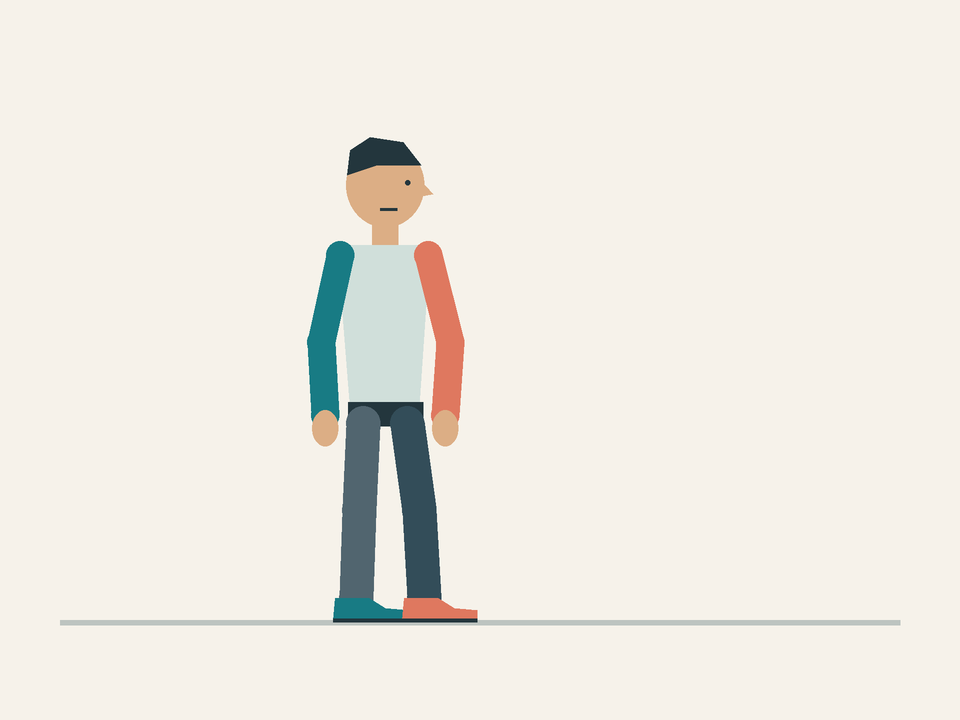
Original authored illustration for reading and comparison; not a generated result.
2. Action phases and fixed relationships
Track shoulder-to-belt and belt-to-knee directions separately. The shoulder line may move forward and down while the belt area stays above the planted legs. The head follows the upper body without supplying a second nod. Hands may travel slightly with the torso; pinning them to screen coordinates would stretch the arms.
| Phase | Relationship to inspect |
|---|---|
| 1 | Upright: torso and thigh directions are readable. |
| 2 | Hinge: the torso inclines forward relative to the thighs. |
| 3 | Pause: one bowed pose is visible with both soles still planted. |
| 4 | Return: the same torso rises to a quiet upright ending. |
Phases specify order, not exact timing controls. The review diagram is an authored checklist, not output frames or an ending-frame input.
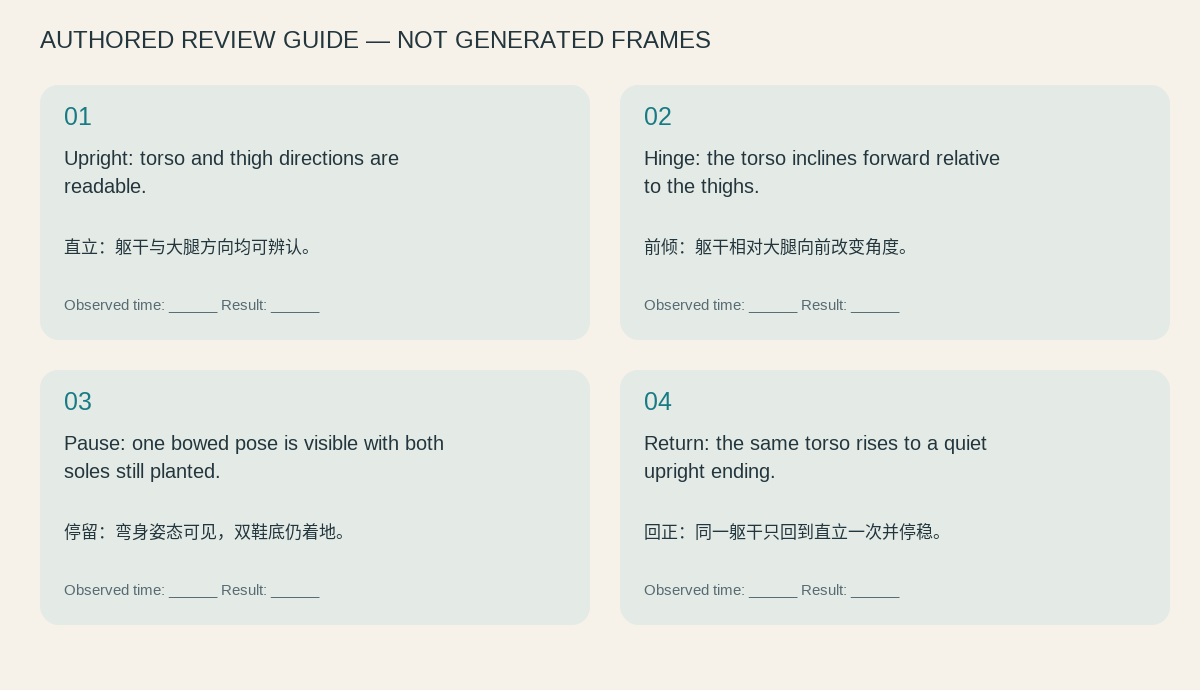
Original authored illustration for reading and comparison; not a generated result.
3. Prepare one manual task
- Use the supplied side view to compare the tunic edge with the forward thigh. Do not judge a bow by face direction alone; a head nod can move the nose without changing the torso.
- Describe a modest hinge and one return. Keep the knees nearly unchanged instead of requesting a deep bend that would turn the task into a squat.
- During review, compare the torso-to-thigh relation at the deepest visible lean. Then check both soles and the belt area for translation across the floor.
- Inspect the reversal from lean to upright in the same take. A cut at the lowest position or a freeze followed by a new body does not show a return.
Prepare one authorized full-body adult side view in an upright standing pose. Keep the hip, thigh and torso relationship and both planted shoes visible, with clear space in front for a modest hip hinge.
Open the image-to-video workspace and select MiniMax H3 base mode if available. If First Frame is hidden and the interface offers Add end frame, enable it to reveal the frame roles. Upload only your prepared authorized image to First Frame, leaving the optional Last Frame empty. Copy the full prompt from this page manually and match its appearance details to your image. Inspect current controls and the actual estimate; stop if the mode or first-frame role is unavailable or a second image is required. The link does not upload an image or insert a prompt. Keep annotated review diagrams out of the input slots.
4. Complete original prompt
The full prompt below describes the page example. For your own image, match appearance, colors and role names to the actual visible source while retaining the action order and review goal. The example is not automatically supplied to the workspace.
Begin from the original side-view standing adult mannequin, facing picture right with both shoes on the level floor. Keep the camera and floor still. The torso inclines forward gently from the hip area into one modest bow; the upper body changes angle relative to the thighs. Keep both soles planted, with no step and no pronounced knee squat. The head follows the torso without a separate nod, and the hands hang beside the legs with small natural accompanying movement. Pause briefly in the bowed pose, then return the same torso to upright once and settle. Preserve limb length and the shoulder-to-belt connection. No rigid rotation of the whole body, fall, chair, cut, repeated bow or change of character. This wording requests visual order, not a measured joint angle.
5. Inspect the actual sequence
Fill observations only when real footage exists. Watch the full take, pause around the relevant contact, separation or order change, then replay at normal speed. Timecode, outcome and note cells start empty. Use pass, fail or not-observable; an obscured event is not a pass.
| Check | Actual timecode | Outcome | Notes |
|---|---|---|---|
| Both shoes remain at their opening contacts. | |||
| The torso-to-thigh angle changes, rather than only the face direction. | |||
| A readable bowed pause appears before return. | |||
| Legs do not collapse into a deep squat. | |||
| Torso and pelvis remain connected without stretching. | |||
| One continuous return ends upright without a second bow. |
Use these in-page rows or copy them into your own notes. Enter actual observations only after reviewing a result; use pass, fail or not-observable. Keep the image you actually submitted, complete prompt, selected settings, real task reference and result location with those observations. Hidden or blurred contact remains not-observable.
6. Change one failed variable
- Only the head nods → revise only the torso-relative-to-thigh sentence; do not increase head movement.
- Whole figure tilts like a board → emphasize only the hinge location and unchanged foot contacts.
- Knees drop into a squat → reduce only requested knee change while retaining the torso hinge.
- Bow repeats → make the single return and final hold explicit; inspect the complete ending.
7. Retain evidence and task boundaries
Save observations from upright, deepest visible lean and returned upright. The drawing and method establish no cultural standard of bowing, joint-angle accuracy or safe physical exercise.
The eye-and-head owner deliberately keeps the torso fixed. The seated-rise owner changes hip height and seat support. The magician prompt uses two bows as one event inside a costume-swap spectacle; this independent input and review task isolates torso-versus-thigh motion and its reversal.
This page contains original text and a program-drawn fictional mannequin, with no real-person material or third-party images. The original geometry may be used and adapted for this project and practice. It does not establish permission for a real likeness or a third-party brand. The text and schematic examples are original authored material.