Task template
MiniMax H3 loose-knot prompt: tighten without swapping the crossings
Trace one original open rope path with three authored over-under crossings before requesting a small tightening. Includes the path data, PNG and blank review sheet; no physical knot or safety test is supplied.
MiniMax-H3 · image-to-video · Original task method; generation has not been independently verified.
Start generating video →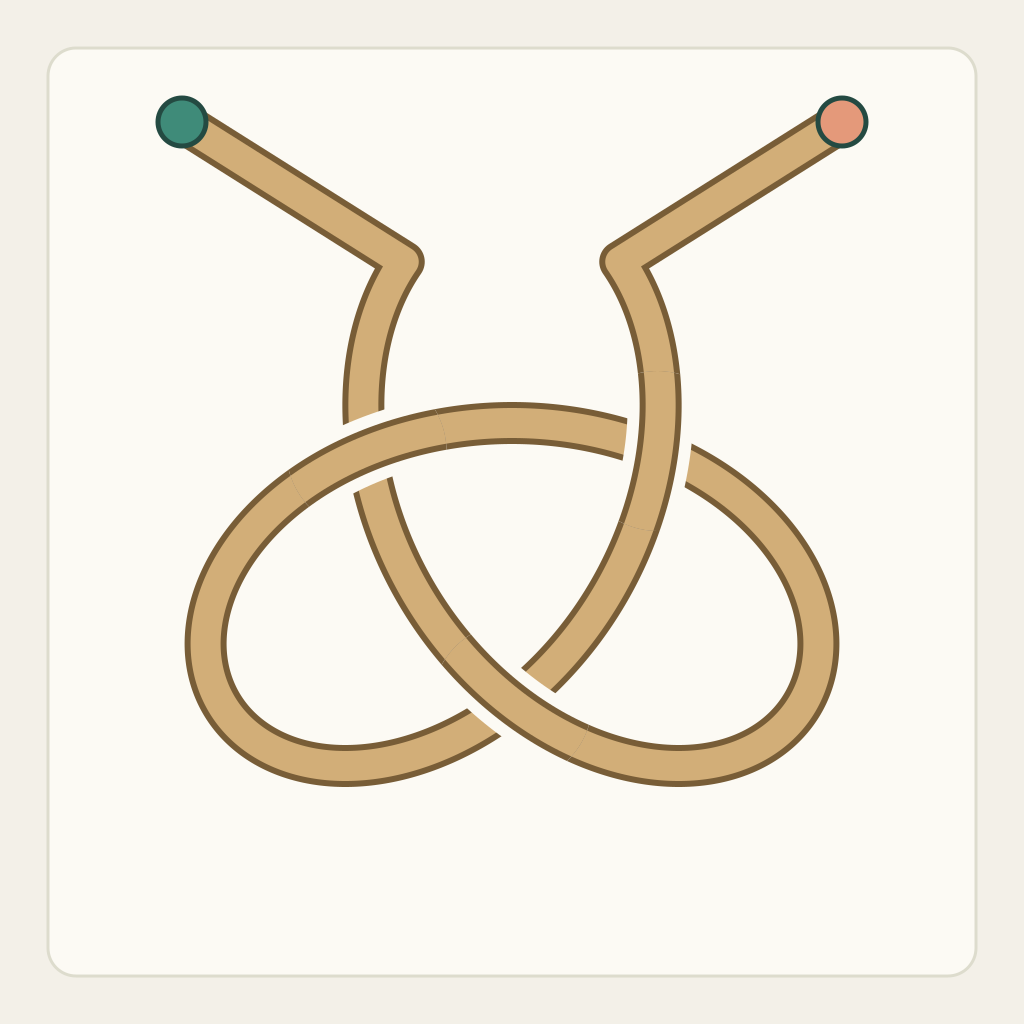
MiniMax H3 loose-knot prompt: tighten without swapping the crossings
Reduce an already formed loose knot while keeping the same rope route. This is not a request to tie a new knot from straight ends, and it is not a real-world tying or load-bearing lesson.
Original practice illustrations and an untested method. No H3 task has been submitted and no generated result is included.
Establish the authored starting state
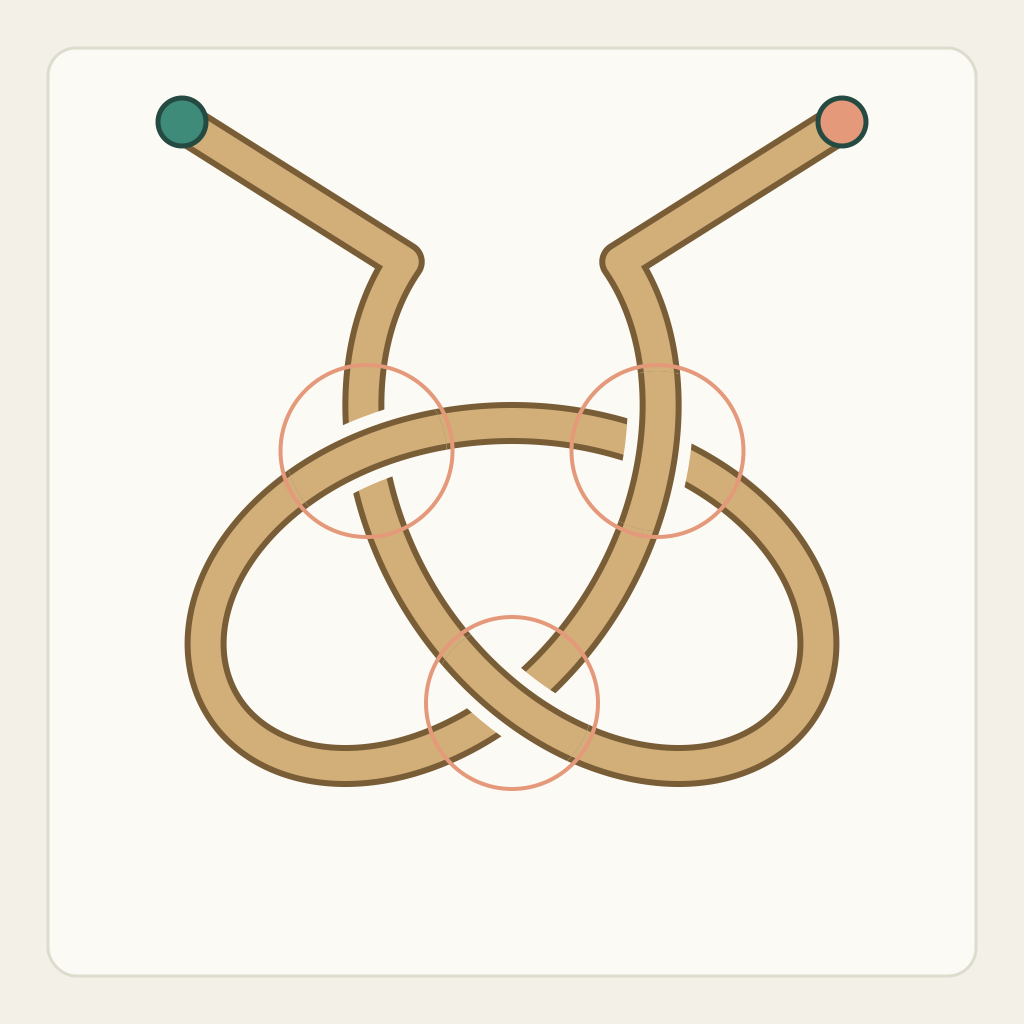
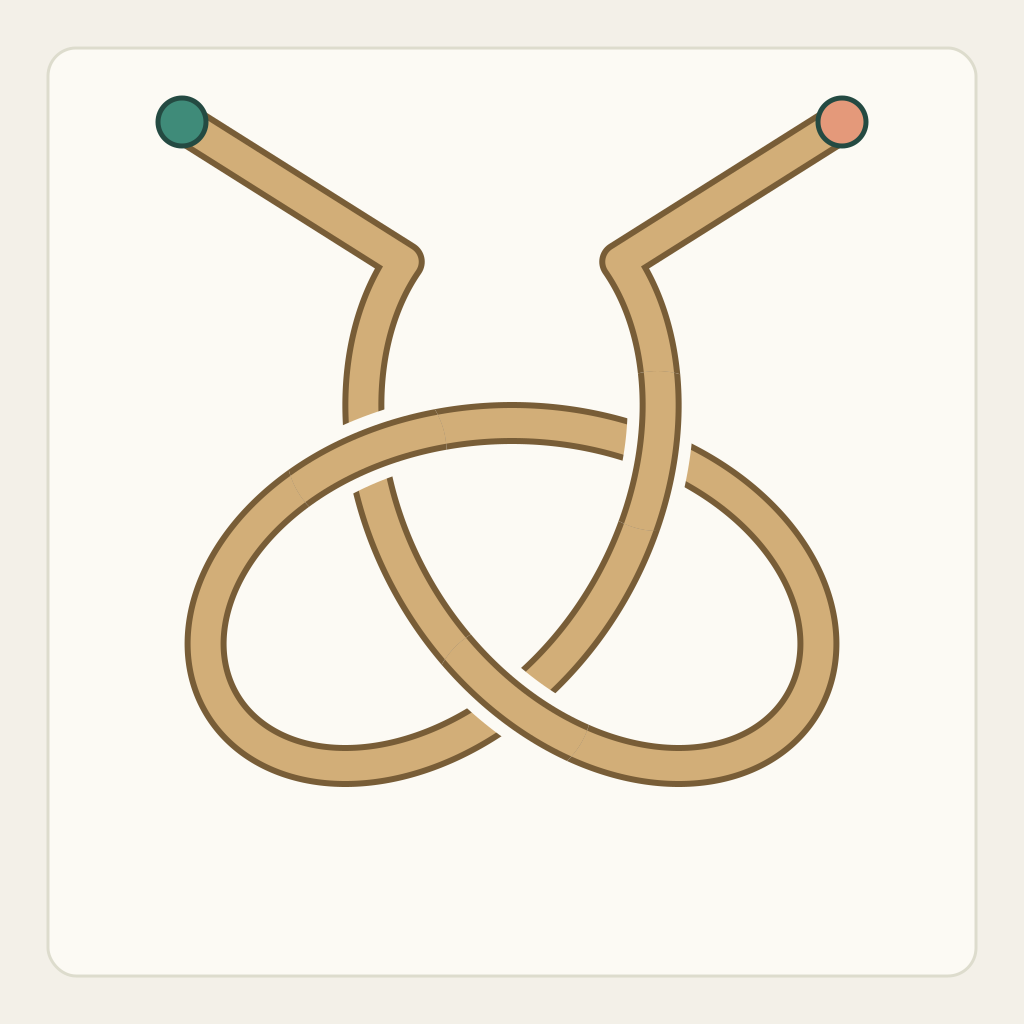
The input is a flat drawing of one continuous ochre rope. Its two endpoints have distinct teal and coral caps. Three projected crossings have explicit front/back occlusion, generated from one open three-dimensional parameter path; rope-path.json records the original points and which branch is above at each crossing. The drawing is an authored loose single-knot diagram, not a reconstructed physical rope or a guarantee about hidden three-dimensional material.
Download the actual input PNG · Editable design SVG
Assign the moving and fixed roles
Start at a colored end cap and trace the same strand through all three crossings to the other cap. An underpass is hidden behind a different part of the same strand, not a cut end. The supplied guide circles the crossing locations only; do not upload it as another frame.
- Before using the prompt, trace from the coral cap to the teal cap and check the three over-under relationships against the separate guide. If you redraw the source and cannot follow one continuous route, stop and fix the drawing first.
- Move the original two ends a small distance outward along their existing upper-left and upper-right exit directions. Ask for the current knot body to become more compact, rather than creating an extra loop.
- For a future clip, pause at each crossing while the central body contracts. Compare which branch is in front; a smooth-looking final knot is insufficient if a strand passed through another in the middle.
- Compare end lengths and the fixed canvas. Shortening the central knot should be accompanied by visible change along the free end sections, not a global camera zoom. Stop before making claims about tension, strength or a physically tight endpoint.
Prepare one manual generation attempt
Use the current MiniMax H3 base image-to-video controls. Under the currently documented site workflow, enable Add end frame to expose First Frame, upload only S01-first-frame.png there and leave Last Frame empty. This draft does not use Fast, which needs a paired input. Recheck the actual available controls and credit estimate before any manual submission; these files neither upload themselves nor start generation. SVG files and the separate review guide stay local as design/review materials. No duration, resolution or endpoint capability is promised by this method.
Download the practice package · Blank observation sheet
Use the complete original draft
Use the supplied original loose single-knot illustration as the first frame. It contains one ochre rope with one teal end cap, one coral end cap and three already defined over-under crossings. Keep the camera and pale background fixed. Gently draw the existing ends a small distance outward along their current upper-left and upper-right exit directions. Let the same central knot become a little more compact as the free end sections extend. Keep both colored caps on the original endpoints and preserve the existing front/back order at every crossing. The rope stays one continuous strand: no cutting, solid pass-through, fused junction, exchanged crossing, extra knot or new rope. Do not untie it into a straight line or turn it into linked rings. Stop with the same slightly more compact knot and both ends visible. This is an untested visual continuity request, not a physical tying, tension or safety demonstration.The copyable generator draft is the English version; the paired Chinese draft is included for review.
Inspect the actual result in sequence
Do not fill a pass from the input or from the intended ending. Enter observations only after examining actual result frames. The downloadable sheet has empty observation and result fields.
- Exactly two original colored end caps remain on the same continuous strand.
- Each original over-under crossing keeps its front/back order during motion.
- No visible branch cuts, fuses or passes through the solid rope at a crossing.
- The central knot becomes modestly more compact while free end sections visibly adjust.
- The canvas and camera stay fixed; whole-image scaling is not counted as tightening.
- The ending is the same single knot with two ends, not a new knot, chain, bag opening or straight cord.
Repair one failure without changing the task
- If an overpass becomes an underpass, keep the source and reduce only the tightening amount; inspect that crossing before changing the whole prompt.
- If the rope splits or fuses at a junction, restate only that each crossing is an occlusion of one strand, not a branching connection.
- If the whole image shrinks, remove zoom wording and preserve the background frame as a fixed comparison.
- If the knot unties or a second knot appears, change only the ending to a slightly compacted version of the existing knot. An ambiguous original drawing should be corrected instead of explained away.
Save the ending and choose the right next task
Keep a note for each of the three crossings and for both end caps. The supplied route is source geometry for review, not a measured path recovered from a generated clip.
No model task, real tying action, force estimate, load test or safety certification was performed. The geometry describes the authored illustration and cannot establish a usable real knot.
A fixed-eyelet task passes a cord through a separate rigid hole; a drawstring gathers fabric without a knot; a chain preserves adjacency among separate rigid rings. None supplies this one-strand self-crossing route.