One side step and close: lead foot lands before the follower moves
Plan one lateral step toward picture right, followed by the other foot closing the stance. The character should travel across a stationary frame. The check is a sequence of changing foot contacts, not a moving background that creates an impression of travel.
Plan one lateral step toward picture right, followed by the other foot closing the stance. The character should travel across a stationary frame. The check is a sequence of changing foot contacts, not a moving background that creates an impression of travel.
Original geometric practice input; untested teaching method. No H3 call or generated result is included.
1. Input and task goal
The original front-facing adult stands left of frame center with open floor space to picture right. The picture-right shoe is coral and the picture-left shoe is teal. Two small fixed wall marks are far from the body. Both feet are separated, both soles are visible and neither leg crosses the other.
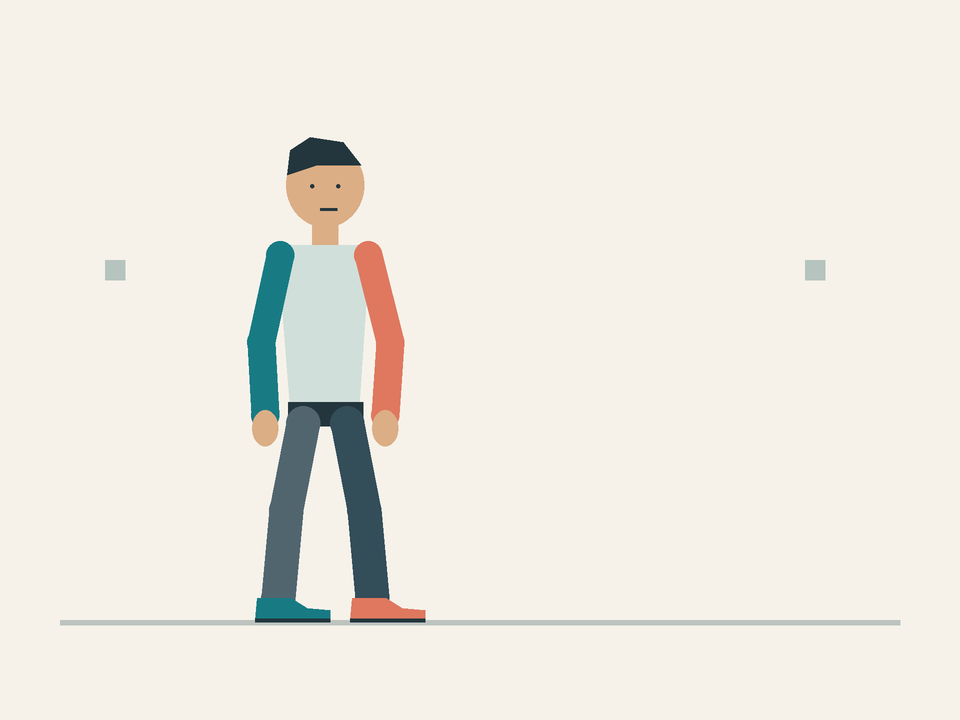
Original authored illustration for reading and comparison; not a generated result.
2. Action phases and fixed relationships
The coral shoe leads toward picture right; the teal shoe follows only after that landing. Screen directions avoid ambiguity about the character’s anatomical left. The wall marks and floor stay fixed while the adult changes screen position. The torso can shift over a supporting leg; locking its center would contradict a sideways step.
| Phase | Relationship to inspect |
|---|---|
| 1 | Start: both shoes contact the floor with a modest gap. |
| 2 | Lead: coral shoe lifts, travels right and lands while teal stays down. |
| 3 | Close: teal shoe leaves its old contact and moves toward coral without crossing. |
| 4 | Stop: both shoes land with a small remaining gap; body faces forward. |
Phases specify order, not exact timing controls. The review diagram is an authored checklist, not output frames or an ending-frame input.
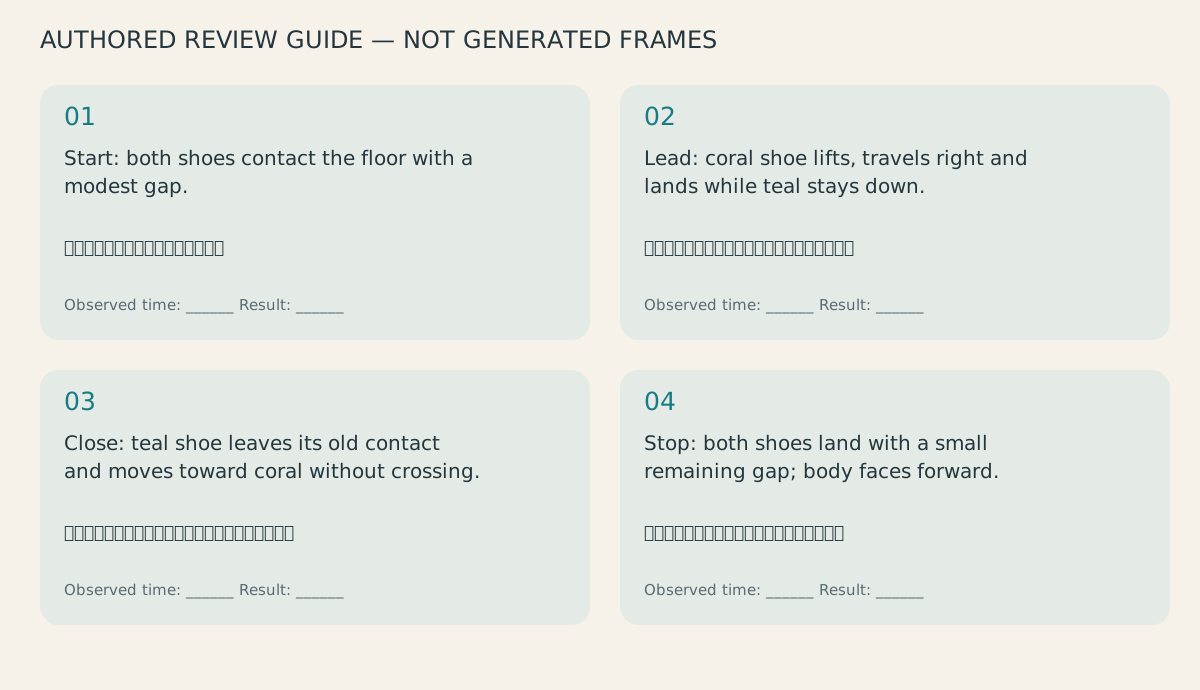
Original authored illustration for reading and comparison; not a generated result.
3. Prepare one manual task
- Check that the rightward travel fits in the empty half of the image. The person must remain fully framed without a camera follow.
- Specify the lead landing before the follower lifts. Request one step-close, not repeated dance steps or a jump with both feet airborne.
- For a future result, mark the first coral landing and the first teal lift separately. If blur hides their order, record the sequence as not-observable.
- Compare wall marks at start and finish, then inspect the final gap between shoes. Background drift, crossed legs or feet sliding together are separate failures.
Prepare one authorized full-body frontal adult image with two distinct shoes on a level floor. Leave clear space toward frame right for one side step and keep both foot contacts readable against the fixed background.
Open the image-to-video workspace and select MiniMax H3 base mode if available. If First Frame is hidden and the interface offers Add end frame, enable it to reveal the frame roles. Upload only your prepared authorized image to First Frame, leaving the optional Last Frame empty. Copy the full prompt from this page manually and match its appearance details to your image. Inspect current controls and the actual estimate; stop if the mode or first-frame role is unavailable or a second image is required. The link does not upload an image or insert a prompt. Keep annotated review diagrams out of the input slots.
4. Complete original prompt
The full prompt below describes the page example. For your own image, match appearance, colors and role names to the actual visible source while retaining the action order and review goal. The example is not automatically supplied to the workspace.
Start from the supplied front-facing fictional-adult drawing, standing left of center. The coral shoe on picture right leads. Keep the camera, floor and distant wall marks still. Lift the coral shoe and take one modest side step toward picture right while the teal shoe remains on the floor. After the coral shoe visibly lands, lift the teal shoe from its old position and bring it toward the coral shoe, stopping with a small gap and no crossing. Let the torso shift naturally with this sequence while the body keeps facing forward. End with both shoes down and the adult still. Preserve the two leg identities and the same body. No simultaneous two-foot hop, continuous shuffle, backward step, camera tracking, cut or repeated step-close.
5. Inspect the actual sequence
Fill observations only when real footage exists. Watch the full take, pause around the relevant contact, separation or order change, then replay at normal speed. Timecode, outcome and note cells start empty. Use pass, fail or not-observable; an obscured event is not a pass.
| Check | Actual timecode | Outcome | Notes |
|---|---|---|---|
| The coral foot moves first while teal remains in contact. | |||
| Coral lands before teal lifts to follow. | |||
| The two shoes do not cross or exchange identities. | |||
| The body shifts right relative to fixed wall marks. | |||
| Each traveling shoe lifts rather than continuously sliding along the floor. | |||
| Both feet finish down with a gap and no new step beginning. |
Use these in-page rows or copy them into your own notes. Enter actual observations only after reviewing a result; use pass, fail or not-observable. Keep the image you actually submitted, complete prompt, selected settings, real task reference and result location with those observations. Hidden or blurred contact remains not-observable.
6. Change one failed variable
- Both feet hop → strengthen only the lead-contact-before-follow clause.
- Teal starts before coral lands → add only a readable lead landing pause; do not change travel distance.
- The camera follows → remove only camera travel and compare the distant wall marks again.
- Feet cross at closure → reduce only the follower travel, preserving the lead step.
7. Retain evidence and task boundaries
Keep the initial contacts, lead landing, follower lift and final placement as separate observations. No rhythm, dance skill, measured weight transfer or frame-accurate ordering has been tested.
The tracking-walk owner keeps a walking figure near screen center with a moving camera. This task holds the camera still and ends after a finite lateral lead-and-close. The ballroom prompt combines side steps, spins, costume movement and tracking; it supplies no isolated lead-landing-before-follower record.
This page contains original text and a program-drawn fictional mannequin, with no real-person material or third-party images. The original geometry may be used and adapted for this project and practice. It does not establish permission for a real likeness or a third-party brand. The text and schematic examples are original authored material.