Elastic-ring prompt: expand over a taper, then recover below the collar
Keep a closed loop identifiable while its opening changes to pass an obstacle.
Original deterministic practice input; generation method untested. No H3 call or generated output is included.
1. Task and boundary
Keep a closed loop identifiable while its opening changes to pass an obstacle. The ring must widen around the tapered body, clear its widest collar and narrow again around the lower stem. A slit, disappearing back half or uniformly shrinking scene would avoid the actual constraint.
2. Read the first frame and fixed roles
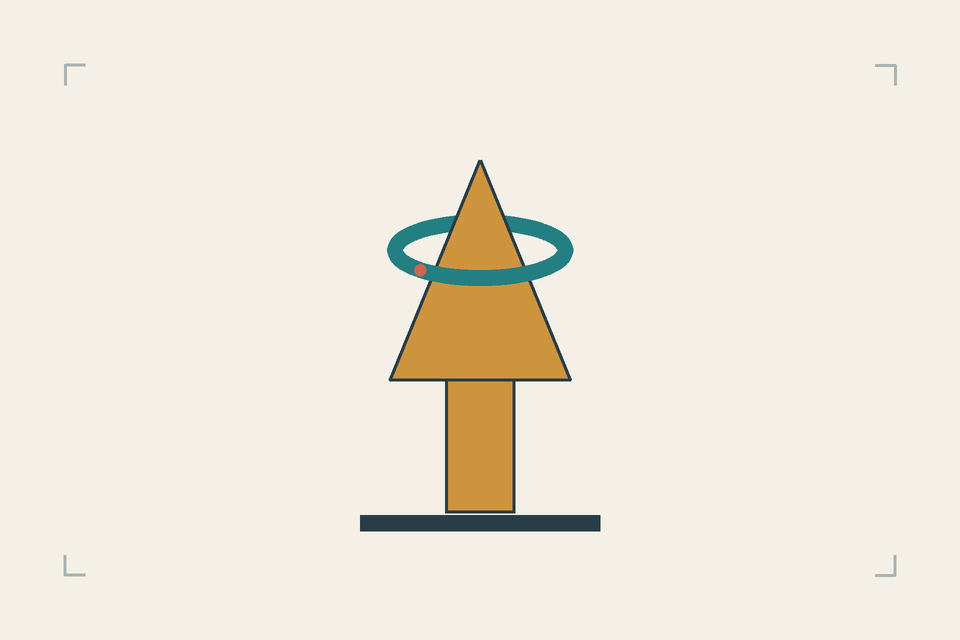
A fixed ochre mandrel has a narrow pointed upper region, a wider lower collar and a narrower stem beneath that collar. One teal ring loosely surrounds the upper taper. The back arc is occluded by the mandrel while the front arc is visible. A coral dot on the front-left ring segment marks the same material region.
Track the mandrel tip, collar corners, lower stem and the coral dot. The ring has one hole and remains a single closed band; only its shape and opening change. The oblique ellipse is a drawing convention, not a measured section, stretch ratio or material specification.
3. Prepare your input and one attempt
To try this image-to-video task, use a photo or drawing you own or have permission to use. It must show the starting arrangement described in section 2: the same visible parts, contact gaps, fixed supports and identifying marks. The illustration above is a reading example. If your image differs, adapt the object, color and marker names in the prompt to what is actually visible; if a required contact or movement space is missing, prepare a suitable image before submitting. You can still read the example and plan the action without running a generation.
Select MiniMax H3 base and place your prepared image in the supported First Frame slot, leaving Last Frame empty. If Add end frame is needed to expose that slot, enable it without adding an ending image. Check the current controls, offered settings and credit estimate before submitting. Copy the complete prompt in section 4 and use the criteria in section 5 to inspect the result. The prompt link prepares text only; it does not upload an image or submit a task. No paid generation was used to prepare this example.
4. Prompt and operating sequence
Use your prepared, authorized image of the fixed mandrel and single teal ring. Lock the camera and ochre mandrel. Move the ring slowly down around the taper. Let its opening expand progressively to pass around the widest collar while the band stays one closed loop with its coral front-left mark attached. Once the whole ring has cleared below that collar, let it narrow again around the thinner lower stem and stop. Keep front/back occlusion coherent: the rear arc stays behind the mandrel and the front arc remains in front. No slit, cut ends, duplicate ring, solid pass-through, mandrel shrink or entire-scene scaling. End with one recovered loop surrounding the original lower stem. This is a visual deformation request, not a material-strength test.
- Locate the collar and the narrower stem below it. A simple cone with no narrower region would not support the requested recovery-after-clearance ending.
- Request one downward pass. Describe gradual widening along the taper before clearance, then narrowing only after the entire ring is below the collar. Keep it around the stem.
- In a future result, inspect the front and visible side arcs during maximum opening. Track the coral dot after recovery and check that a hidden rear arc has not become an invented break or extra free end.
5. Inspect an actual result
Use the criteria below while watching an actual result. In your own notes, record each criterion, its time or frame, the visible observation and your judgment: pass, fail or inconclusive. Leave the observation and judgment empty until you have inspected the output. Mark an obscured contact inconclusive instead of substituting the intended ending for evidence of the transition.
- The mandrel tip, collar and lower stem remain fixed and unchanged.
- The ring opening widens before it passes the widest collar.
- One closed band persists without a slit, free ends or an extra ring.
- The front/back overlap remains consistent while the ring descends.
- The coral mark stays attached to the same ring region through expansion and recovery.
- Recovery occurs below the collar, and the final ring still surrounds the narrower stem.
6. Repair one failure at a time
- Ring clips through the collar: enlarge the visible opening request before clearance, without shrinking the mandrel.
- Ring opens into a C shape: emphasize one continuous closed band and inspect its two visible sides.
- Recovery begins too early: make the lower-stem position the condition for narrowing; do not use a cut to conceal passage.
7. Save the ending and choose related tasks
Save the pre-collar, widest-opening and recovered observations. No allowable strain, sealing function, assembly force or real elastomer behavior is established. No generation run has been performed.
The sponge changes a solid volume between pads, while the drawstring gathers a fabric mouth using two free cord ends. This original input is a closed annulus with no ends, and its hole must clear a fixed collar before recovering around a different shaft section.
Source: the illustration, geometry, prompt and inspection criteria were authored for this page without third-party images, font files, trademarks or people. They are teaching examples, not real-product performance evidence or H3 output. For your own input, retain its source and permission record.