Uncross the arms: keep each wrist attached through the overlap
Open a crossed-arm pose without swapping forearms at the central overlap. The task begins with one forearm visibly in front of the other and ends with two separated arms; the important evidence lies while they separate.
Open a crossed-arm pose without swapping forearms at the central overlap. The task begins with one forearm visibly in front of the other and ends with two separated arms; the important evidence lies while they separate.
Original geometric practice input; untested teaching method. No H3 call or generated result is included.
1. Input and task goal
The original front-facing adult is framed from head to hips. A coral sleeve begins at the picture-left shoulder and its forearm crosses in front. A teal sleeve begins at the picture-right shoulder and passes behind that coral segment. The visible simplified hands rest near opposite upper arms. This deliberately authored overlap is the starting challenge, not an accidental crop.
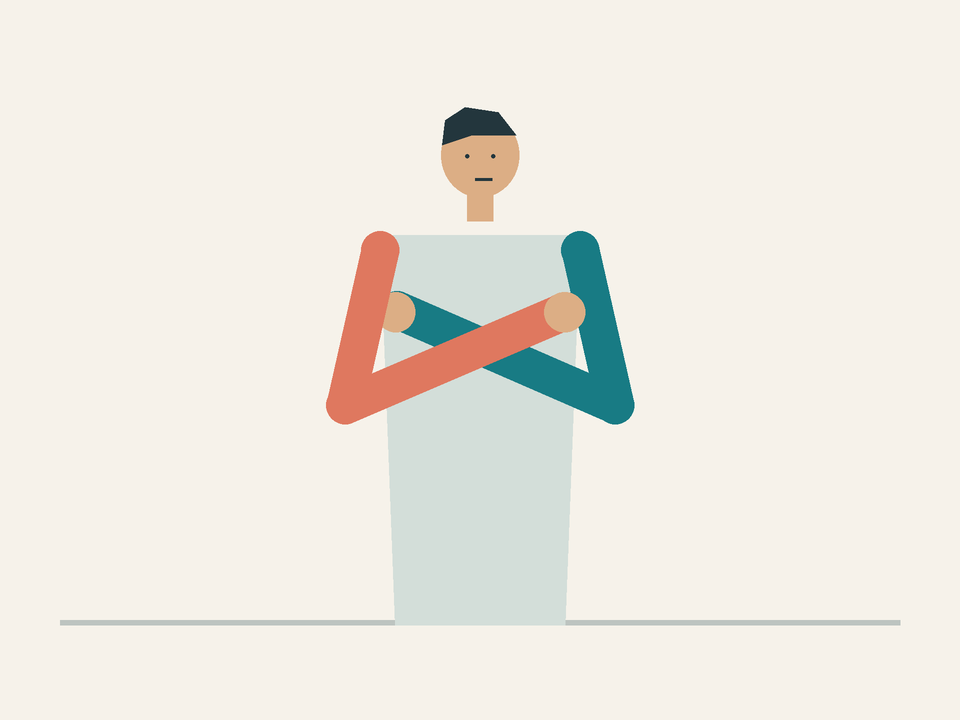
Original authored illustration for reading and comparison; not a generated result.
2. Action phases and fixed relationships
Follow a complete connection from each shoulder to elbow to wrist. Sleeve colors help but do not replace connection tracing. The front coral forearm moves clear first; the teal forearm opens once the overlap is released. Keep the torso facing forward and both shoulders in frame. Hands are simplified shapes, so this input cannot certify detailed finger anatomy.
| Phase | Relationship to inspect |
|---|---|
| 1 | Crossed: coral forearm is visibly in front of teal. |
| 2 | Clear: coral forearm moves outward, revealing the continuous teal connection. |
| 3 | Open: teal forearm opens without passing through coral. |
| 4 | Rest: both arms hang apart beside the same torso. |
Phases specify order, not exact timing controls. The review diagram is an authored checklist, not output frames or an ending-frame input.
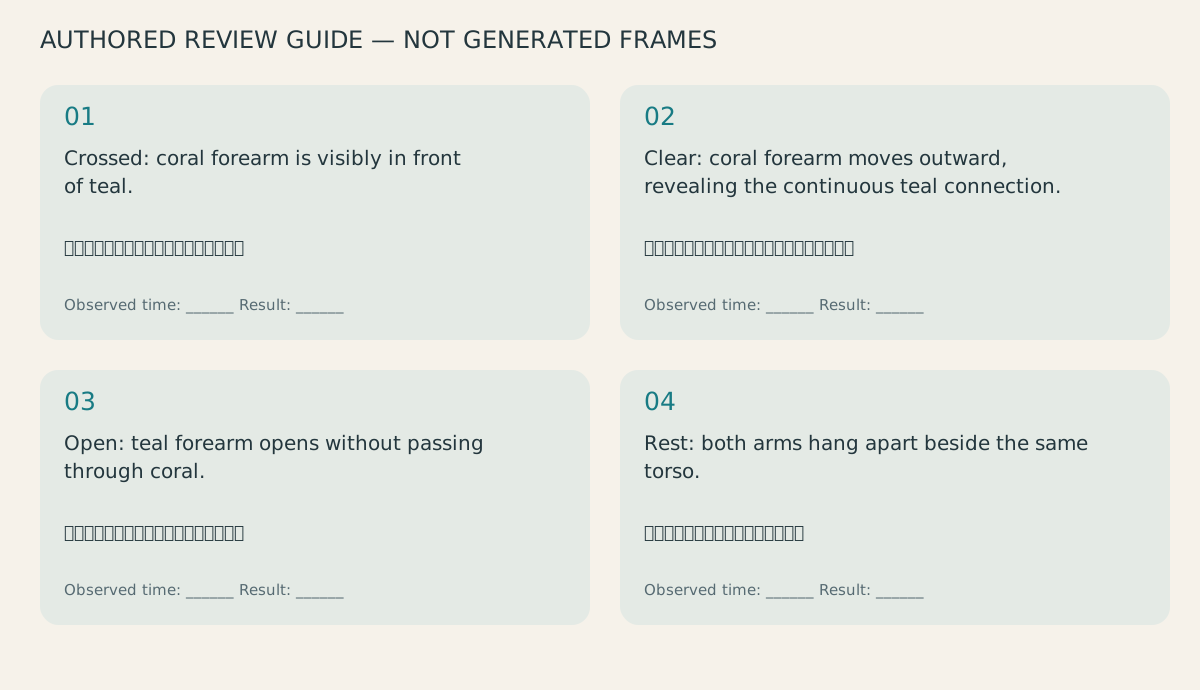
Original authored illustration for reading and comparison; not a generated result.
3. Prepare one manual task
- Read the overlap before drafting. Identify which contour disappears behind which sleeve; do not use a replacement with both elbows cropped out.
- Request the front forearm clearing first, then the rear forearm opening. Both may move naturally, but the rear wrist must not teleport to the opposite elbow.
- When actual footage exists, inspect the first revealed strip of the teal forearm. Trace it back to its original elbow, rather than accepting a matching cuff color alone.
- Replay from the crossed opening through both wrists becoming separate. A two-armed ending is insufficient if the middle briefly creates a third forearm.
Prepare one authorized frontal adult image framed from head to hips with crossed forearms. Make the front and rear arm distinguishable and keep both shoulders, elbows and wrists visible, so each hand can be traced to its original shoulder.
Open the image-to-video workspace and select MiniMax H3 base mode if available. If First Frame is hidden and the interface offers Add end frame, enable it to reveal the frame roles. Upload only your prepared authorized image to First Frame, leaving the optional Last Frame empty. Copy the full prompt from this page manually and match its appearance details to your image. Inspect current controls and the actual estimate; stop if the mode or first-frame role is unavailable or a second image is required. The link does not upload an image or insert a prompt. Keep annotated review diagrams out of the input slots.
4. Complete original prompt
The full prompt below describes the page example. For your own image, match appearance, colors and role names to the actual visible source while retaining the action order and review goal. The example is not automatically supplied to the workspace.
Begin from the supplied original crossed-arm adult illustration. The coral arm starts at the shoulder on picture left and its forearm is in front at the crossing. The teal arm starts at the shoulder on picture right and passes behind it. Keep each shoulder, elbow and wrist connected to its original arm. First move the coral forearm outward enough to clear the overlap. Then let the teal forearm open, with no arm passing through the other. Lower both arms into a relaxed separated position beside the same torso and stop. Keep the body facing forward, the camera fixed and both elbows and wrists visible. No clap, object exchange, sleeve-color swap, extra arm, fused wrist, costume change, cut or recrossing. Preserve the illustrated style; this is an untested continuity brief.
5. Inspect the actual sequence
Fill observations only when real footage exists. Watch the full take, pause around the relevant contact, separation or order change, then replay at normal speed. Timecode, outcome and note cells start empty. Use pass, fail or not-observable; an obscured event is not a pass.
| Check | Actual timecode | Outcome | Notes |
|---|---|---|---|
| The opening has the authored coral-in-front overlap. | |||
| Coral clears the crossing before teal completes opening. | |||
| Teal remains connected to its original shoulder through the reveal. | |||
| Both wrists remain on their original forearms. | |||
| No extra or disconnected arm appears during separation. | |||
| Two distinct arms finish beside the torso without recrossing. |
Use these in-page rows or copy them into your own notes. Enter actual observations only after reviewing a result; use pass, fail or not-observable. Keep the image you actually submitted, complete prompt, selected settings, real task reference and result location with those observations. Hidden or blurred contact remains not-observable.
6. Change one failed variable
- Forearms swap at the crossing → clarify only the shoulder-elbow-wrist ownership sentence.
- Arms pass through each other → make only the front-arm-clearance phase explicit.
- A hidden elbow grows an extra arm → use a clearer opening with the same overlap and more elbow space.
- The character changes outfit → remove any reveal or transformation wording; retain only arm separation.
7. Retain evidence and task boundaries
Keep the opening overlap and the first revealed rear forearm as review evidence. There is no generated action or anatomical validation on this page. The purpose is tracing two continuous limb paths through self-occlusion.
The clap owner begins with separated palms and checks brief palm contact. The handoff owner transfers an external cube between hands. The costume-change prompt includes crossing and opening arms as a transition trigger; this authored input keeps clothing fixed and tests hidden-limb reconnection instead of a visual transformation.
This page contains original text and a program-drawn fictional mannequin, with no real-person material or third-party images. The original geometry may be used and adapted for this project and practice. It does not establish permission for a real likeness or a third-party brand. The text and schematic examples are original authored material.