MiniMax H3 conveyor prompt: carry a parcel with its moving support
Separate a moving support surface from a fixed machine frame.
Separate a moving support surface from a fixed machine frame. The parcel should travel because it remains supported by the moving top belt, without rolling itself or being followed by the camera.
Original illustrated practice input; method not independently tested. No H3 generation or model output is supplied. A result, if you later generate one, still needs the checks below.
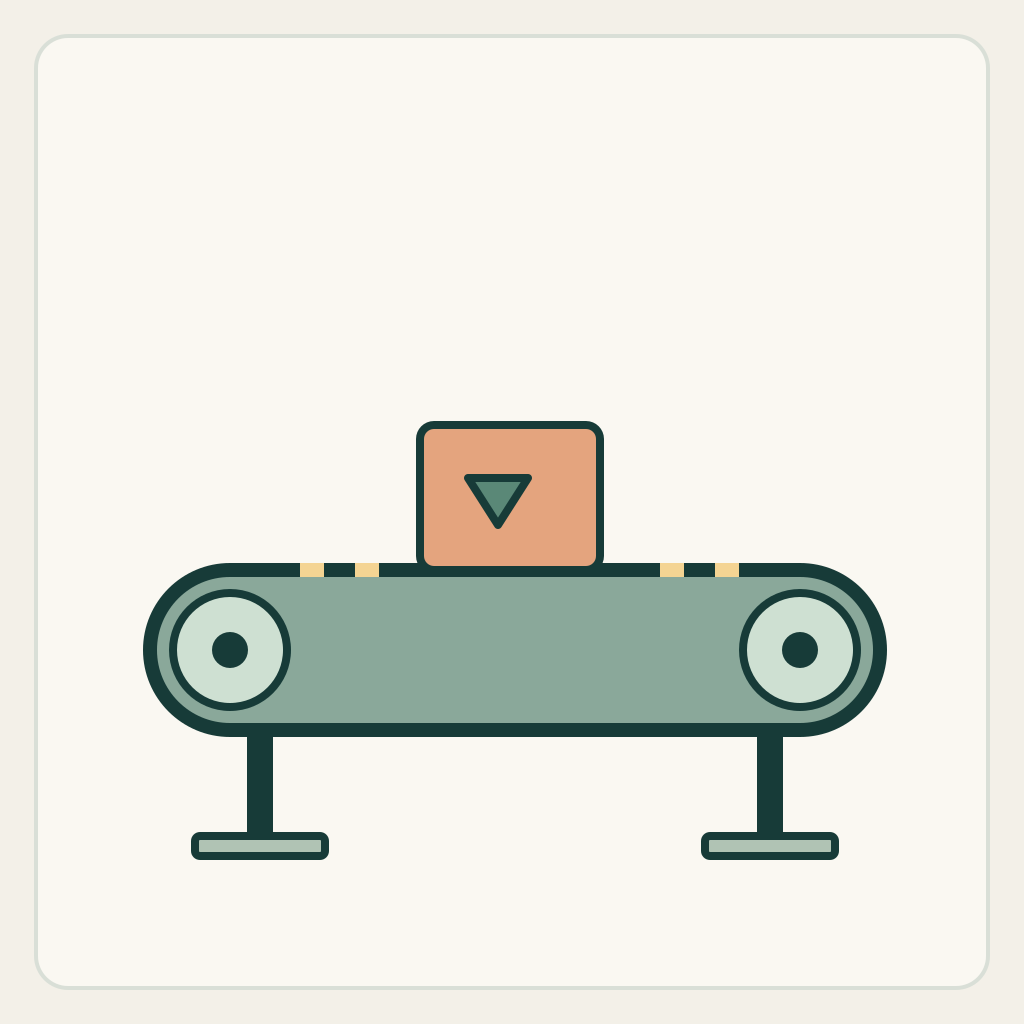
For an actual attempt, prepare a photo or drawing you own or have permission to use. Match the visible starting arrangement, contact gaps, fixed supports and identifying marks described below. Adapt the prompt’s object, color and style names to your image. If a necessary contact or movement space is missing, fix the input before submitting. The on-page illustration is a reading example; you can plan the action without running a generation.
1. Read the starting input
The original side-view drawing shows a short closed belt around two end rollers, fixed supports and one plain parcel resting on the upper belt edge. Small contrasting marks identify the top belt; a triangle on the parcel makes its orientation visible.
Track the end-roller axles and legs as fixed anchors, not the rotating roller surfaces. Compare the parcel bottom with nearby top-belt marks. The destination is still on the belt, before the right edge.
2. Set up the current generator
Use MiniMax H3 base image-to-video with your prepared image. If needed, enable Add end frame to expose First Frame, put only that image in First Frame and leave Last Frame empty. Check the actual available settings and current credit estimate before manual submission. The prompt is text you can copy; it does not upload your image or start a task. No exact duration, resolution, endpoint or successful result is guaranteed by these instructions.
3. Copy the original prompt
Use your prepared, authorized illustrated first frame with a locked side camera. Keep the conveyor frame, legs and both roller axles stationary. Advance the upper belt toward frame right. The same single parcel travels a short distance to the right with the supporting top belt while its triangle and upright orientation remain unchanged. Keep the parcel bottom in visible contact with the belt; do not let it hover, roll, slide backward relative to nearby belt marks or split into multiple boxes. The roller surfaces may turn around their fixed axles. Stop while the parcel is still fully supported before the right edge, then hold. No camera tracking, no falling off the belt and no seamless-loop claim.
4. Work through one attempt
- Distinguish belt marks, fixed axles and the parcel in your input. If you use a real product input, leave enough visible belt on both sides to compare support motion.
- Ask for one short transport interval. Keep a conveyor-end drop and a repeating loop out of this first attempt; they introduce separate contact and reset questions.
- For a later output, compare the parcel bottom and one nearby belt mark in several frames. Then check the triangle orientation and the fixed frame before judging overall motion smoothness.
5. Inspect the result
For each criterion below, record the time or frame, visible observation and judgment in your own notes: pass, fail or inconclusive. Fill observed values only after inspecting an actual output; the intended ending is not evidence that the transition occurred.
- The machine legs, frame and both roller axles stay fixed in the shot.
- Top-belt marks and the parcel advance toward frame right over the same interval.
- The parcel remains upright and supported, without obvious backward slip, rolling or a gap below it.
- The same single parcel stops before the belt edge; no drop, duplication or loop reset occurs.
6. Change one failure at a time
- If the background moves instead of the support, restate the locked camera and fixed machine frame; do not compensate with a tracking shot.
- If the parcel rolls, name its unchanged triangle orientation and remove any wording about turning or rotating the product.
- If contact floats or slides, shorten the travel and compare a local belt mark; speed changes make this relationship harder to inspect.
7. Ending, limits and related tasks
The original upright parcel rests farther right on the same belt, still fully supported and short of the edge. The machine frame remains where it started.
This checks visible support and relative motion, not belt traction, load capacity, industrial safety or a friction coefficient. It is an untested H3 teaching method.
Use the rolling exercise when the object itself turns against the ground. Use this exercise when the supporting surface supplies the travel.