Task template
Snap-latch animation prompt: bend the hook, clear the shoulder, then seat
Show why a small latch stays seated. A plug merely disappearing into a socket cannot establish that a flexible hook crossed a retaining shoulder and returned behind it. This exercise isolates that visible locking sequence in a fictional side-view mechanism.
MiniMax-H3 · image-to-video · Original task method; generation has not been independently verified.
Start generating video →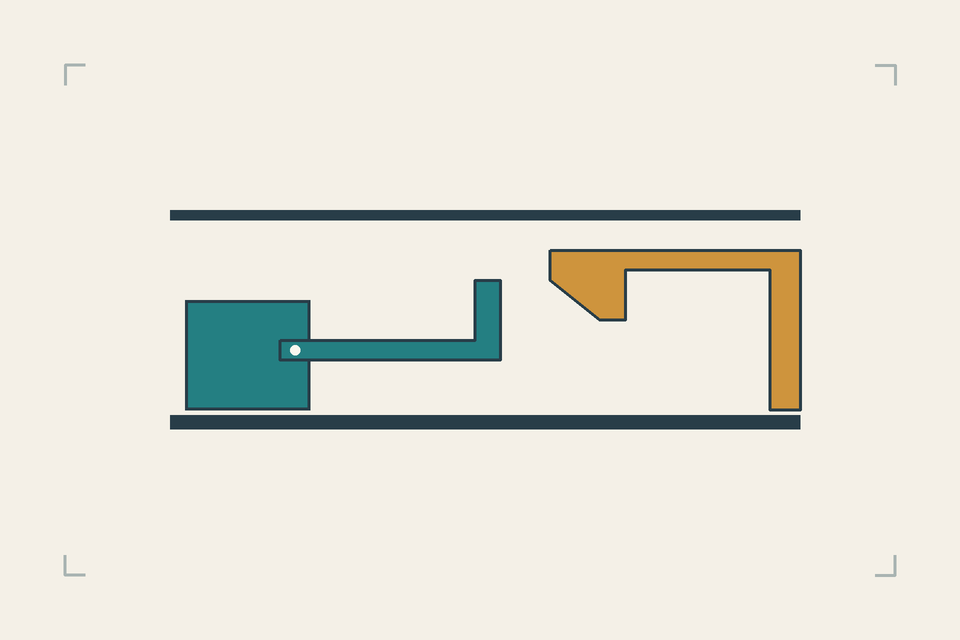
Snap-latch animation prompt: bend the hook, clear the shoulder, then seat
Original deterministic practice input; generation method untested. No H3 call or generated output is included.
Task and boundary
Show why a small latch stays seated. A plug merely disappearing into a socket cannot establish that a flexible hook crossed a retaining shoulder and returned behind it. This exercise isolates that visible locking sequence in a fictional side-view mechanism.
Read the first frame and fixed roles
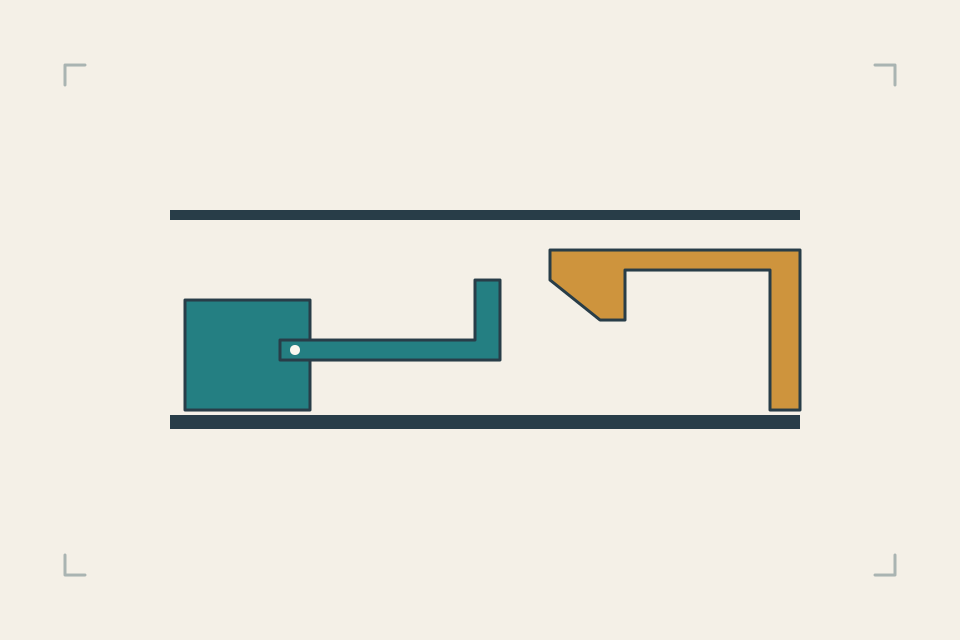
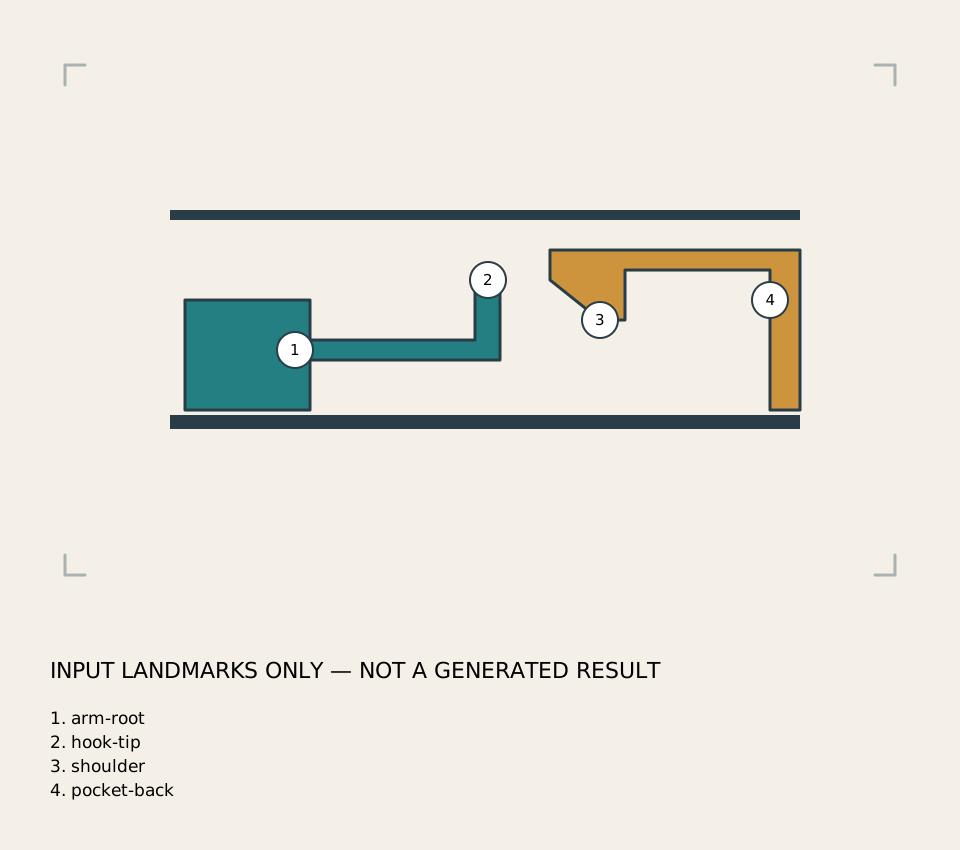
The teal carriage sits left of a fixed ochre receiver. One narrow teal arm grows from the carriage and ends in an upward hook. The receiver has a sloped entry shoulder and a recessed pocket behind it. The open side view exposes the hook, shoulder and pocket; there is no cover hiding their contact. Two dark guide rails constrain the carriage to horizontal travel.
Keep both guide rails and the receiver corners fixed. Follow the arm root on the carriage, the hook tip, the top of the retaining shoulder and the rear wall of the pocket. Only the slender arm may bend; the carriage must keep its shape. The input is an authored schematic, not a dimensioned snap-fit design.
Download and prepare one attempt
Use the PNG as the uploadable first frame. Keep the SVG and numbered inspection guide local for editing and review. The kit also contains both prompt languages, a blank CSV with bilingual criteria and source notes. Follow the site’s single-first-frame base image-to-video workflow: select MiniMax H3 base, put first-frame.png in the supported First Frame slot and leave Last Frame empty. If Add end frame is needed to expose that slot, enable it but do not supply an ending image. Do not select a Fast flow that requires paired inputs. Check the controls, offered settings and credit estimate before any later submission. The link prepares text only; it does not upload or submit. No paid generation was used to make this package.
PNG · SVG · ZIP · CSV · Review guide
Open prompt draft
Prompt and operating sequence
Use this original open side-view latch illustration as the first frame. Lock the camera, ochre receiver and dark horizontal guides. Move the teal carriage slowly right. Its single upper hook first contacts the sloped entry shoulder; the slender attached arm bends downward enough to pass beneath that shoulder. After the same hook clears the shoulder into the visible pocket, the arm returns upward and the hook rests behind the shoulder. Keep the arm root attached to the same carriage throughout, with no break, melting or new latch. Keep the carriage rigid and the receiver stationary. Stop seated after one insertion. No hands, housing cover, camera motion, activation light, cut or withdrawal. Show the contact and recovery rather than cutting directly to a locked-looking ending.- Locate the hook and trace its intended rightward route. It must meet the sloped underside of the shoulder before reaching the pocket; do not replace the source with a closed housing that hides this event.
- Request one short insertion. Separate approach, visible downward arm deflection, shoulder clearance and recovery in that order. End as soon as the hook is behind the shoulder.
- For a future result, pause at first contact, maximum visible bend and the seated hold. Compare the root-to-carriage attachment in all three frames. A seated last frame alone cannot prove the arm bent or recovered.
Inspect an actual result
Fill timestamps, observations and pass/fail only after inspecting an actual result. The sheet contains no prefilled passes. Mark an obscured contact inconclusive instead of substituting the intended ending for evidence of the transition.
- The receiver and both guide rails remain fixed while the carriage advances right.
- The hook first meets the existing shoulder; downward bending starts at that contact.
- The same slender arm stays attached at its original carriage root and does not split.
- The hook clears the shoulder before the arm recovers upward.
- The final hook sits behind the shoulder inside the original pocket, without solid intersection.
- One latch remains visible in the ending; no second hook or unexplained housing change appears.
Repair one failure at a time
- Hook passes through the shoulder: inspect the open-side clearance in the input and request a smaller, slower insertion. Do not hide contact behind a new cover.
- Whole carriage bends: name the slender arm as the only flexible region and compare carriage corners.
- Arm remains bent after seating: restate recovery only after shoulder clearance. Do not accept the pocket concealing a missing hook.
Save the ending and choose related tasks
Save three contact observations and the seated hold. This brief supplies no pull-out test, force, fatigue life, material selection or safe fastening specification. No MiniMax H3 generation has been performed.
The connector owner checks rigid alignment, insertion depth and an attached cable. The sponge owner checks a soft volume between pads. This input exposes a thin cantilever and retaining pocket; the decisive test is bend-before-clearance and recovery-behind-shoulder, not depth or bulk compression.
Source: the illustration, geometry, prompt and checklist were authored for this package. No third-party image, bundled font, trademark or person is used. They are teaching schematics, not real-product performance evidence or H3 output. The download includes a source and rights declaration; independent review remains pending.
Related files
- cantilever-snap-latch-seat-README-en-md
- cantilever-snap-latch-seat-README-zh-md
- cantilever-snap-latch-seat-RIGHTS-txt
- cantilever-snap-latch-seat-acceptance-blank-csv
- cantilever-snap-latch-seat-first-frame-png
- cantilever-snap-latch-seat-first-frame-svg
- cantilever-snap-latch-seat-landmarks-json
- cantilever-snap-latch-seat-package-files-json
- cantilever-snap-latch-seat-practice-kit-zip
- cantilever-snap-latch-seat-prompt-en-txt
- cantilever-snap-latch-seat-prompt-zh-txt
- cantilever-snap-latch-seat-review-guide-svg
- cantilever-snap-latch-seat-source-geometry-json
- cantilever-snap-latch-seat-task-definition-json