Cam-follower animation prompt: keep contact through rise, dwell and return
Plan a single cam action where a guided follower changes height because the supporting contour changes.
Original deterministic practice input; generation method untested. No H3 call or generated output is included.
1. Task and boundary
Plan a single cam action where a guided follower changes height because the supporting contour changes. The important interval is the high dwell: the cam keeps turning while the follower briefly stays at nearly the same height. This is a visual timing brief for an authored profile.
2. Read the first frame and fixed roles
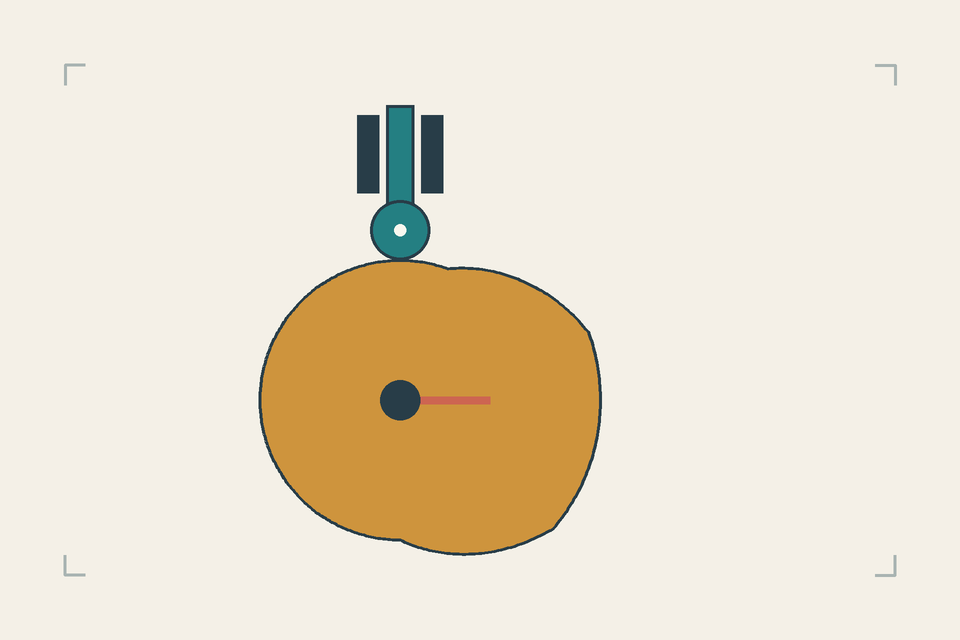
The ochre cam has a low circular region, a rising flank and a broad high arc. A teal roller sits directly on its top contour and is attached to a vertical stem running between two dark guides. The dark cam hub is fixed. A coral radial mark distinguishes turning from a whole-profile morph.
The cam hub and guides are anchors. The roller center may move vertically; the roller touches the outer profile. No rod joins the cam hub to the follower. The broad high arc is intentional: a generic eccentric circle would not provide the same authored dwell region.
3. Prepare your input and one attempt
To try this image-to-video task, use a photo or drawing you own or have permission to use. It must show the starting arrangement described in section 2: the same visible parts, contact gaps, fixed supports and identifying marks. The illustration above is a reading example. If your image differs, adapt the object, color and marker names in the prompt to what is actually visible; if a required contact or movement space is missing, prepare a suitable image before submitting. You can still read the example and plan the action without running a generation.
Select MiniMax H3 base and place your prepared image in the supported First Frame slot, leaving Last Frame empty. If Add end frame is needed to expose that slot, enable it without adding an ending image. Check the current controls, offered settings and credit estimate before submitting. Copy the complete prompt in section 4 and use the criteria in section 5 to inspect the result. The prompt link prepares text only; it does not upload an image or submit a task. No paid generation was used to prepare this example.
4. Prompt and operating sequence
Use your prepared, authorized cam and guided roller schematic. Lock the camera, dark cam hub and two vertical stem guides. Rotate the same ochre cam slowly so its rising flank passes under the teal roller, lifting the attached stem vertically. Keep the roller against the visible contour. As the broad high circular arc passes beneath it, keep the follower briefly near the same high position while the coral cam mark continues turning. Then let the falling flank lower the follower toward its starting height, still in contact. Keep the cam profile rigid, the stem inside its guides and the roller attached to the stem. No connecting rod, floating gap, sideward stem motion, extra lobe or camera move. End after this one rise, dwell and return, with all original parts visible.
- Check that the first roller visibly meets the low contour. Keep the guide gap aligned with the roller center; a misplaced stem would introduce sideways movement before the main task.
- Request a turn that carries the rising flank, high arc and falling flank underneath the roller, then stop. State that the follower is kept against the contour; do not ask it to float independently.
- Inspect three intervals rather than only two heights: rising contact, turning during a near-constant high position, and return contact. A follower frozen for the entire shot is not a dwell.
5. Inspect an actual result
Use the criteria below while watching an actual result. In your own notes, record each criterion, its time or frame, the visible observation and your judgment: pass, fail or inconclusive. Leave the observation and judgment empty until you have inspected the output. Mark an obscured contact inconclusive instead of substituting the intended ending for evidence of the transition.
- The hub and both vertical guides stay fixed.
- The same rigid cam profile turns; the lobe does not grow under a stationary mark.
- The roller rises only vertically as the rising flank arrives beneath it.
- During the high interval, the cam mark keeps moving while follower height changes little.
- The roller remains in contact during return without passing inside the cam.
- The stem stays between the guides and the ending retains the original roller attachment.
6. Repair one failure at a time
- Follower lifts away from the cam: make profile contact the first constraint and reduce rotation speed language.
- No dwell appears: ensure the input still has a broad high arc and request only a brief hold while the mark rotates.
- Cam becomes a crank: exclude rods and preserve the visible surface-contact pair; do not add a pin to force motion.
7. Save the ending and choose related tasks
Record the three intervals and the cam mark positions. No cam equation, acceleration limit, preload, contact stress or manufactured profile is validated. No model output or exact timing guarantee is included.
The crank-slider page transmits motion through a rigid rod with two pivots and explicitly stops before a reversal. This task needs direct rolling contact, a vertical guide and a high dwell between rise and return. It uses a different input and a different temporal test.
Source: the illustration, geometry, prompt and inspection criteria were authored for this page without third-party images, font files, trademarks or people. They are teaching examples, not real-product performance evidence or H3 output. For your own input, retain its source and permission record.