Task template
Bowed-strip animation prompt: press through the centerline into the opposite arch
Describe one change between two bowed poses while both endpoints stay in place. The distinguishing ending is an inverted arch that remains after the pressing pad withdraws. This is an authored visual target; the drawing alone cannot prove that a real strip would be bistable.
MiniMax-H3 · image-to-video · Original task method; generation has not been independently verified.
Start generating video →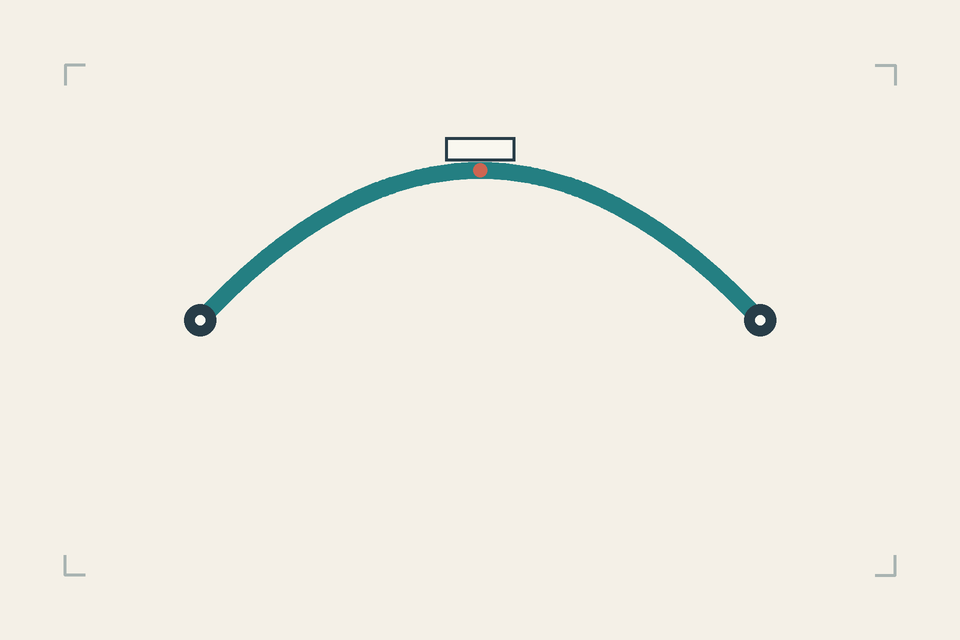
Bowed-strip animation prompt: press through the centerline into the opposite arch
Original deterministic practice input; generation method untested. No H3 call or generated output is included.
Task and boundary
Describe one change between two bowed poses while both endpoints stay in place. The distinguishing ending is an inverted arch that remains after the pressing pad withdraws. This is an authored visual target; the drawing alone cannot prove that a real strip would be bistable.
Read the first frame and fixed roles
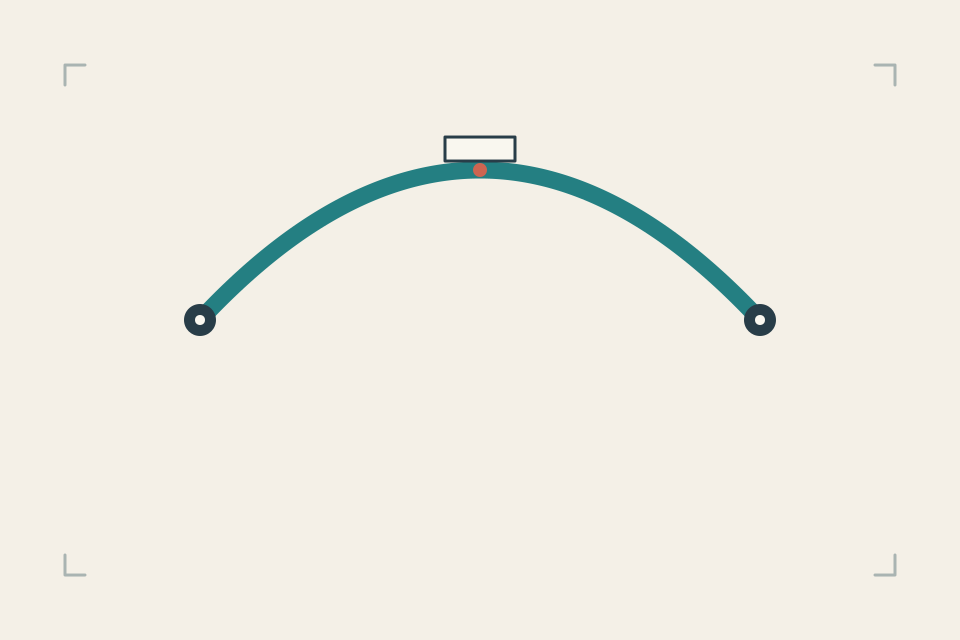
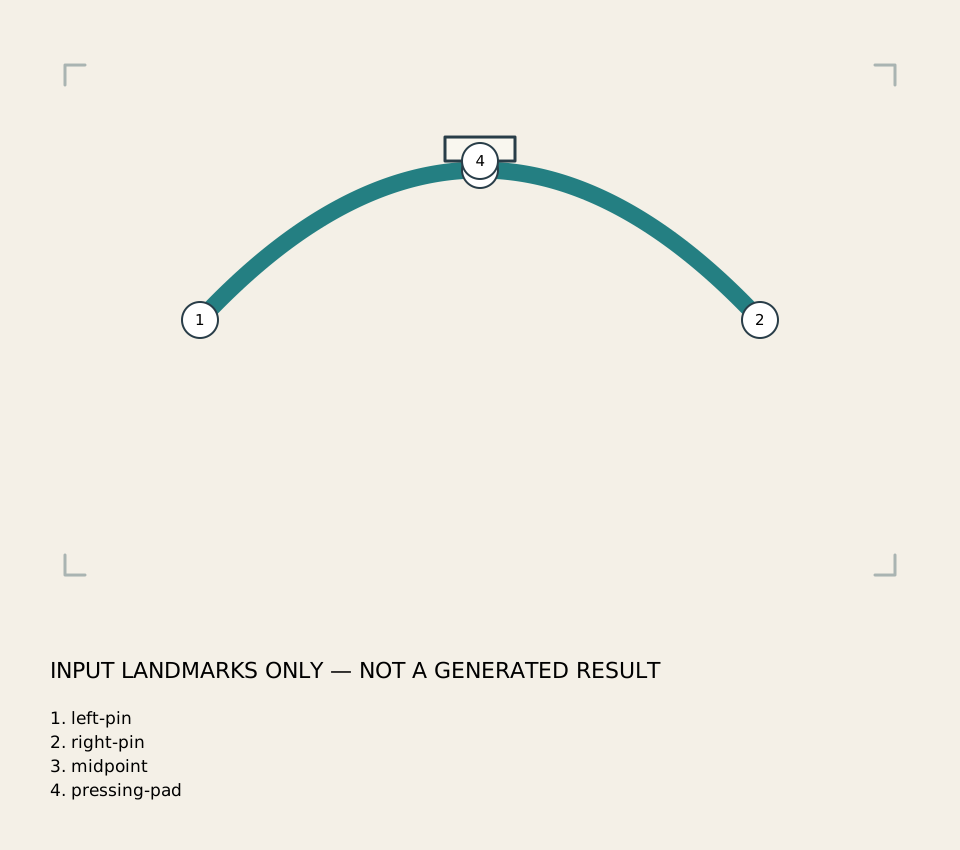
One smooth teal strip curves upward between two fixed dark endpoint pins. A coral midpoint dot sits at the crown. A small pale pressing pad touches the crown from above; open space below the pin-to-pin line leaves room for the inverted pose. There are no crease hinges or stacked panels.
Keep both pins and the background fixed. The pad translates vertically and the strip remains attached at both ends. Follow the coral midpoint relative to the imaginary straight line joining the pins. That line is an inspection reference, not an extra object to generate.
Download and prepare one attempt
Use the PNG as the uploadable first frame. Keep the SVG and numbered inspection guide local for editing and review. The kit also contains both prompt languages, a blank CSV with bilingual criteria and source notes. Follow the site’s single-first-frame base image-to-video workflow: select MiniMax H3 base, put first-frame.png in the supported First Frame slot and leave Last Frame empty. If Add end frame is needed to expose that slot, enable it but do not supply an ending image. Do not select a Fast flow that requires paired inputs. Check the controls, offered settings and credit estimate before any later submission. The link prepares text only; it does not upload or submit. No paid generation was used to make this package.
PNG · SVG · ZIP · CSV · Review guide
Open prompt draft
Prompt and operating sequence
Start from the original smooth bowed-strip illustration. Fix both dark endpoint pins and the camera. Move the pale pad straight downward against the coral-marked crown. Let the same connected teal strip flatten and pass through the line between its fixed endpoints into a downward bow, without adding a hinge, tear or extra strip. Then lift the pad clear. Keep the strip in the opposite downward-bowed pose after the pad withdraws, with the coral dot still on its original midpoint region and both endpoints attached. No moving supports, permanent pad contact, accordion folds, camera zoom or cut between poses. Show one press-and-withdraw sequence. This is a proposed visual snap-through, not a verified prediction of spring behavior.- Locate both endpoints, then compare the midpoint height with their shared horizontal line. A replacement image needs clear open space below, otherwise inversion would collide with the floor or disappear out of frame.
- Request a single downward press through the endpoint line, followed by pad withdrawal. State the intended opposite arch after release rather than a return to the original bow.
- Review the connected strip before crossing, while crossing and after the pad has separated. A lower pose held down by the pad does not yet establish the requested released ending.
Inspect an actual result
Fill timestamps, observations and pass/fail only after inspecting an actual result. The sheet contains no prefilled passes. Mark an obscured contact inconclusive instead of substituting the intended ending for evidence of the transition.
- Both endpoint pins stay fixed and the strip stays attached to them.
- The coral midpoint crosses from above to below the endpoint line.
- The transition keeps one smooth connected strip without new discrete hinges or tears.
- The pad presses vertically and later visibly separates from the strip.
- After separation, the strip remains bowed downward for the ending hold.
- The same midpoint mark and two endpoints remain identifiable; no replacement strip appears.
Repair one failure at a time
- Supports move inward to fake the bow: fix each pin and compare their separation before judging the midpoint.
- Strip becomes a folded accordion: name a smooth band with no crease lines and reduce unrelated surface detail.
- The strip springs back after pad withdrawal: restate the opposite-pose ending; if it still fails, record that failure rather than claiming the supplied shape physically guarantees stability.
Save the ending and choose related tasks
Save the midpoint crossing and a frame where the withdrawn pad no longer touches the strip. This is not a measured spring, real bistability certificate, force-displacement curve or fatigue assessment. The method has not been tested on H3.
The sponge returns approximately to its original outline after release; accordion paper closes existing panel hinges. This task uses no discrete hinges and ends in the opposite smooth arch after external contact is removed. The endpoint-line crossing and released hold are distinct acceptance events.
Source: the illustration, geometry, prompt and checklist were authored for this package. No third-party image, bundled font, trademark or person is used. They are teaching schematics, not real-product performance evidence or H3 output. The download includes a source and rights declaration; independent review remains pending.
Related files
- anchored-strip-snap-through-README-en-md
- anchored-strip-snap-through-README-zh-md
- anchored-strip-snap-through-RIGHTS-txt
- anchored-strip-snap-through-acceptance-blank-csv
- anchored-strip-snap-through-first-frame-png
- anchored-strip-snap-through-first-frame-svg
- anchored-strip-snap-through-landmarks-json
- anchored-strip-snap-through-package-files-json
- anchored-strip-snap-through-practice-kit-zip
- anchored-strip-snap-through-prompt-en-txt
- anchored-strip-snap-through-prompt-zh-txt
- anchored-strip-snap-through-review-guide-svg
- anchored-strip-snap-through-source-geometry-json
- anchored-strip-snap-through-task-definition-json