Task template
Rocking-tile prompt: alternate edge contact, reduce the tilt, then settle flat
Watch the support change under one rigid object. A tile starts tilted on one lower corner, rocks across its base to the other and makes a smaller return before resting flat. There is no neighboring object to trigger a cascade and no continuous rolling surface.
MiniMax-H3 · image-to-video · Original task method; generation has not been independently verified.
Start generating video →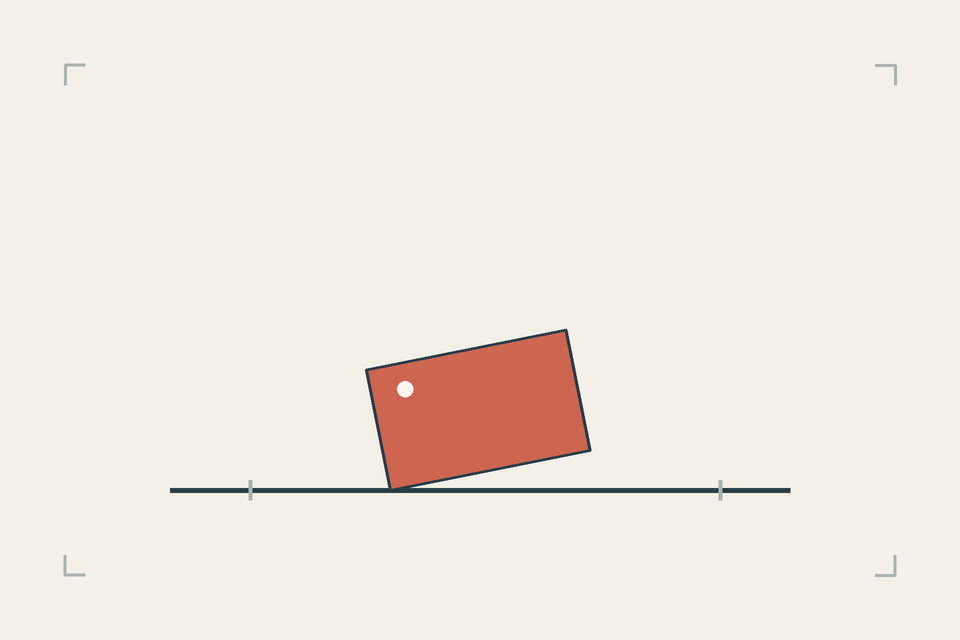
Rocking-tile prompt: alternate edge contact, reduce the tilt, then settle flat
Original deterministic practice input; generation method untested. No H3 call or generated output is included.
Task and boundary
Watch the support change under one rigid object. A tile starts tilted on one lower corner, rocks across its base to the other and makes a smaller return before resting flat. There is no neighboring object to trigger a cascade and no continuous rolling surface.
Read the first frame and fixed roles
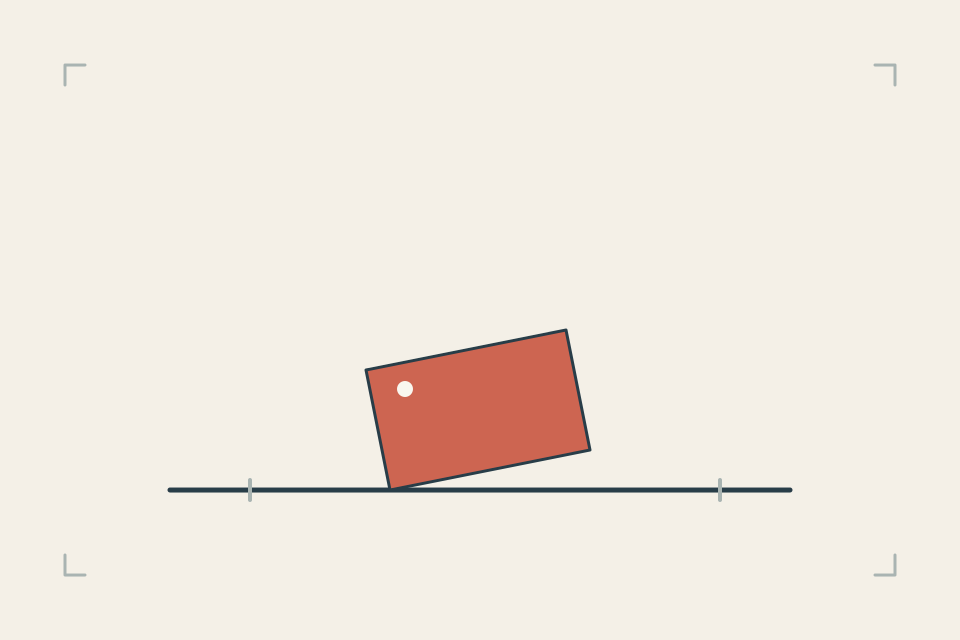
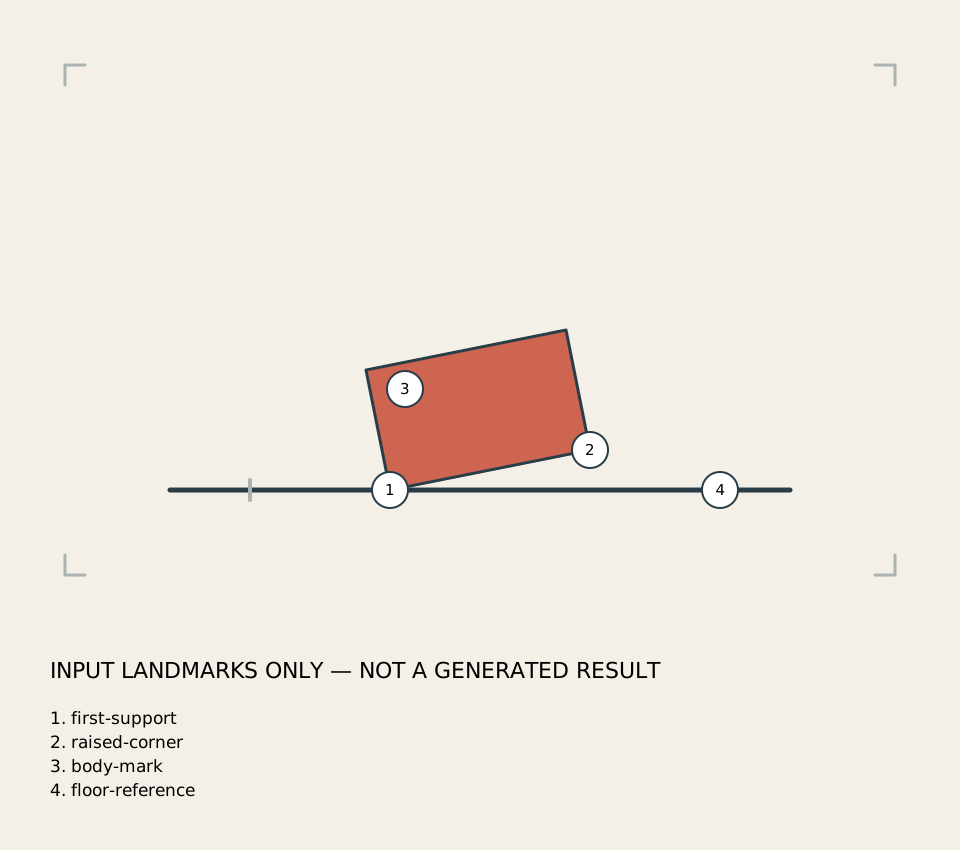
A single squat coral tile rests with its lower-left corner on a fixed floor line while its lower-right corner is visibly raised. A small pale dot identifies its upper-left region. The tile is wide enough for both bottom corners to remain distinguishable. Two muted floor ticks provide position references beside it.
Track the lower-left corner, lower-right corner, pale mark and floor ticks. The corners alternate support as the body tilts; the rectangular tile does not bend. The camera and floor stay still so a changing support is not confused with a rotating picture.
Download and prepare one attempt
Use the PNG as the uploadable first frame. Keep the SVG and numbered inspection guide local for editing and review. The kit also contains both prompt languages, a blank CSV with bilingual criteria and source notes. Follow the site’s single-first-frame base image-to-video workflow: select MiniMax H3 base, put first-frame.png in the supported First Frame slot and leave Last Frame empty. If Add end frame is needed to expose that slot, enable it but do not supply an ending image. Do not select a Fast flow that requires paired inputs. Check the controls, offered settings and credit estimate before any later submission. The link prepares text only; it does not upload or submit. No paid generation was used to make this package.
PNG · SVG · ZIP · CSV · Review guide
Open prompt draft
Prompt and operating sequence
Begin with the original single coral tile tilted on its lower-left corner. Lock the camera, floor line and floor ticks. Let the rigid tile rock toward its lower-right corner, transferring support across its existing base, then rock back through a smaller tilt. Reduce the rocking until the same full bottom edge rests flat on the floor. Preserve the rectangular silhouette and pale mark throughout. During each tilt one bottom corner contacts the floor while the other lifts; at the exchange the original base reaches the floor without sinking through it. No neighboring tiles, domino cascade, elastic bending, bouncing fully airborne, sliding across the scene or camera rotation. End with one quiet tile resting on its full base.- Confirm the starting contact is only at the lower-left corner and the other bottom corner has a visible floor gap. A flat starting tile would require an extra initiating push not supplied here.
- Request a small rock toward the other support, followed by a smaller return and a flat hold. Keep the motion in the original floor neighborhood rather than asking it to tumble away.
- Inspect each support exchange and the final base. Note whether the lifted corner descends to the floor before becoming the new pivot, and whether later tilt is smaller than the first.
Inspect an actual result
Fill timestamps, observations and pass/fail only after inspecting an actual result. The sheet contains no prefilled passes. Mark an obscured contact inconclusive instead of substituting the intended ending for evidence of the transition.
- The floor line and both reference ticks remain fixed.
- The original two bottom corners can be followed throughout the motion.
- Support changes from the initial corner to the opposite corner without either passing below the floor.
- The tile stays rigid; its pale mark stays attached and its outline does not squash.
- The return tilt is visibly smaller rather than an endless equal-amplitude loop.
- The ending rests on the full original bottom edge, without another restart or floating gap.
Repair one failure at a time
- Tile slides instead of rocking: describe the two corner pivots and compare the floor ticks.
- The object squashes at contact: keep the tile rigid and request less tilt; do not add soft-material language.
- Rocking never settles: specify one smaller return and a full-base hold, then inspect the last interval rather than only the final still.
Save the ending and choose related tasks
Save one observation per support exchange and one for the settled base. This qualitative exercise does not measure friction, restitution, center of mass or real damping. No generated result is included.
Dominoes transfer motion through contacts between four separate tiles. A cylinder couples center travel with rotation on a curved surface. Here one rigid tile repeatedly changes which existing bottom corner supports it, and the diminishing motion must end on the full flat base.
Source: the illustration, geometry, prompt and checklist were authored for this package. No third-party image, bundled font, trademark or person is used. They are teaching schematics, not real-product performance evidence or H3 output. The download includes a source and rights declaration; independent review remains pending.
Related files
- rigid-tile-edge-rock-settle-README-en-md
- rigid-tile-edge-rock-settle-README-zh-md
- rigid-tile-edge-rock-settle-RIGHTS-txt
- rigid-tile-edge-rock-settle-acceptance-blank-csv
- rigid-tile-edge-rock-settle-first-frame-png
- rigid-tile-edge-rock-settle-first-frame-svg
- rigid-tile-edge-rock-settle-landmarks-json
- rigid-tile-edge-rock-settle-package-files-json
- rigid-tile-edge-rock-settle-practice-kit-zip
- rigid-tile-edge-rock-settle-prompt-en-txt
- rigid-tile-edge-rock-settle-prompt-zh-txt
- rigid-tile-edge-rock-settle-review-guide-svg
- rigid-tile-edge-rock-settle-source-geometry-json
- rigid-tile-edge-rock-settle-task-definition-json