Hourglass animation prompt: drain the upper bed through one neck into a growing pile
Connect a shrinking granular bed with a growing deposit through a visible narrow passage.
Original deterministic practice input; generation method untested. No H3 call or generated output is included.
1. Task and boundary
Connect a shrinking granular bed with a growing deposit through a visible narrow passage. Unlike two liquid levels moving together, the new lower material must arrive as separate grains through the neck and accumulate underneath it. The goal is a qualitative transfer, not a clock.
2. Read the first frame and fixed roles
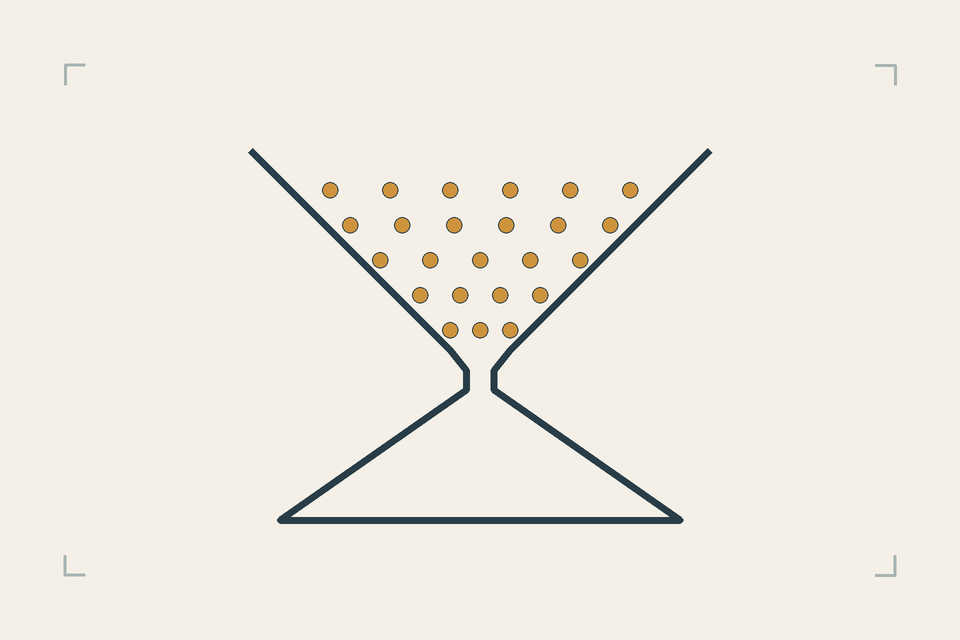
One open front-section hourglass silhouette has a broad upper chamber tapering to a short neck and a lower chamber widening toward a flat floor. Twenty-four ochre grain dots form a loose upper bed; the neck and lower chamber start empty. The cutaway is an authored teaching view, not transparent product photography.
Fix the vessel walls, neck edges and lower floor. Watch the leading grain at the outlet, the upper bed boundary and the apex of the growing lower deposit. Individual grains may overlap in the later pile, so exact hidden-grain counting is not a claimed volumetric measurement.
3. Prepare your input and one attempt
To try this image-to-video task, use a photo or drawing you own or have permission to use. It must show the starting arrangement described in section 2: the same visible parts, contact gaps, fixed supports and identifying marks. The illustration above is a reading example. If your image differs, adapt the object, color and marker names in the prompt to what is actually visible; if a required contact or movement space is missing, prepare a suitable image before submitting. You can still read the example and plan the action without running a generation.
Select MiniMax H3 base and place your prepared image in the supported First Frame slot, leaving Last Frame empty. If Add end frame is needed to expose that slot, enable it without adding an ending image. Check the current controls, offered settings and credit estimate before submitting. Copy the complete prompt in section 4 and use the criteria in section 5 to inspect the result. The prompt link prepares text only; it does not upload an image or submit a task. No paid generation was used to prepare this example.
4. Prompt and operating sequence
Start from your prepared, authorized image of the hourglass cutaway with ochre grains in the upper chamber and an empty lower chamber. Keep the camera, vessel, open neck and lower floor fixed. Let a modest portion of the existing upper grains fall through the narrow neck as distinguishable small grains. The upper bed gradually recedes while grains emerging from that same outlet accumulate into a small pile directly below. Keep the falling path inside the original vessel. Do not turn grains into a continuous liquid ribbon, teleport a ready-made pile into the bottom, widen the neck, add a second outlet or invert the hourglass. Stop before the upper chamber empties and hold a partly drained bed and a small lower pile. No exact seconds, calibrated flow rate or particle simulation is requested.
- Find the lowest upper grain and the still-empty neck. The source must have an open passage; do not begin with a closed stopper and ask material to pass through it.
- Request partial drainage only, leaving material visible in the upper chamber. Keep the neck fixed and ask for a narrow intermittent succession of grains instead of a solid liquid column.
- Review a grain entering the neck, grains leaving it and the lower pile rising beneath that exit. Compare upper loss and lower growth over the same interval, without claiming a calibrated mass balance from projected dots.
5. Inspect an actual result
Use the criteria below while watching an actual result. In your own notes, record each criterion, its time or frame, the visible observation and your judgment: pass, fail or inconclusive. Leave the observation and judgment empty until you have inspected the output. Mark an obscured contact inconclusive instead of substituting the intended ending for evidence of the transition.
- The same vessel outline, open neck and floor remain fixed.
- The first visible transfer enters and exits the original neck.
- Falling material remains granular rather than changing into a liquid sheet.
- The upper bed recedes while the lower deposit grows during the same interval.
- New lower material appears beneath the outlet through visible arrivals, not as an instant full pile.
- The ending keeps grains above and a smaller deposited pile below without inversion or exterior leakage.
6. Repair one failure at a time
- A lower pile appears before any outlet grain: make the initial lower chamber empty and require visible arrival before buildup.
- Neck stretches to drain faster: fix its two edges and request less transfer.
- The flow becomes liquid: retain separated grain marks and remove smooth-pour wording; do not relabel liquid behavior as a granular success.
7. Save the ending and choose related tasks
Save the first outlet event, a mid-transfer view and the partial-drain ending. The initial 24 dots are source geometry, not a guarantee that all occluded output particles can be counted. No timing accuracy, angle of repose or H3 performance was tested.
The connected-vessel page follows two liquid surfaces and an opening valve; the droplet page joins two outlines into one. This task keeps discrete material identity through a fixed constriction and creates a deposit from arrivals. It does not sort two size classes like the sieve exercise.
Source: the illustration, geometry, prompt and inspection criteria were authored for this page without third-party images, font files, trademarks or people. They are teaching examples, not real-product performance evidence or H3 output. For your own input, retain its source and permission record.