Ribbon-unwinding prompt: pay out one strip from a fixed-axis spool
Show a strip becoming free because it unwinds from an existing coil.
Original deterministic practice input; generation method untested. No H3 call or generated output is included.
1. Task and boundary
Show a strip becoming free because it unwinds from an existing coil. A spinning disc with a stretching tail is a common-looking substitute, but it does not explain where the additional ribbon came from. Keep the transfer point visible throughout one short pull.
2. Read the first frame and fixed roles
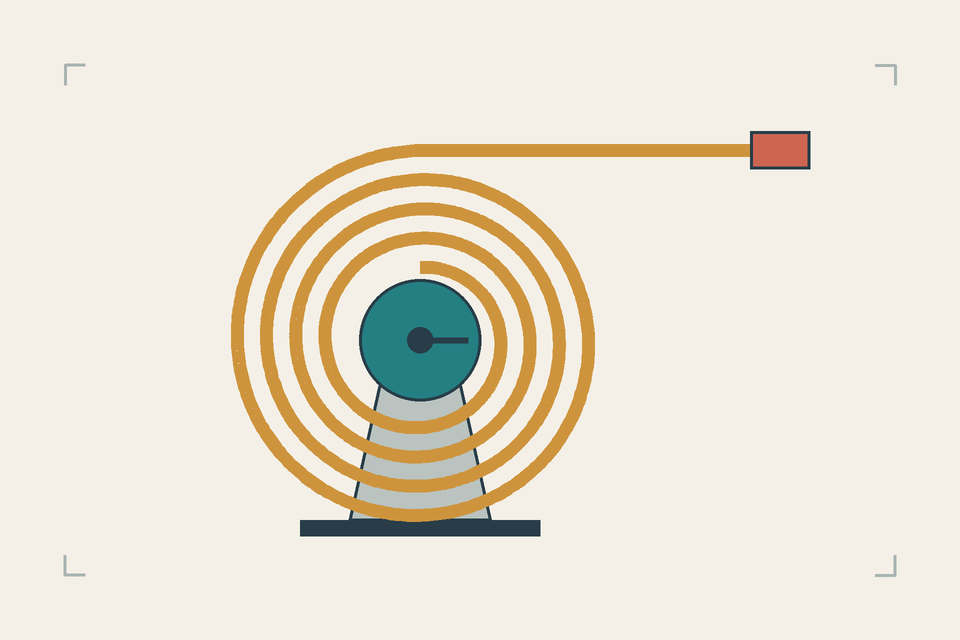
An ochre ribbon is wound around a teal hub on a fixed stand. The outer wrap leaves tangentially from the top and continues right to one coral end tab. A dark radial mark on the hub indicates rotation. The open front view shows the wound region and the single continuous free span.
Fix the hub center and stand. Track the departure point where the ribbon leaves the coil, the two edges of the free strip and the coral tab. The ribbon has width; it is not an infinitely thin line. The frame leaves clear space to the right for a modest payout.
3. Prepare your input and one attempt
To try this image-to-video task, use a photo or drawing you own or have permission to use. It must show the starting arrangement described in section 2: the same visible parts, contact gaps, fixed supports and identifying marks. The illustration above is a reading example. If your image differs, adapt the object, color and marker names in the prompt to what is actually visible; if a required contact or movement space is missing, prepare a suitable image before submitting. You can still read the example and plan the action without running a generation.
Select MiniMax H3 base and place your prepared image in the supported First Frame slot, leaving Last Frame empty. If Add end frame is needed to expose that slot, enable it without adding an ending image. Check the current controls, offered settings and credit estimate before submitting. Copy the complete prompt in section 4 and use the criteria in section 5 to inspect the result. The prompt link prepares text only; it does not upload an image or submit a task. No paid generation was used to prepare this example.
4. Prompt and operating sequence
Begin with your prepared, authorized front-view spool illustration. Fixed camera, fixed stand and fixed teal hub center. Draw the coral end tab slowly to the right, paying out the same ochre ribbon from its existing top outer wrap. Let the hub and coil rotate in the matching unwinding direction. Show material leaving continuously at the tangent departure point as the free span lengthens and the wound outer layer gives up a short section. Keep the ribbon width coherent and the two edges connected from coil to tab. No elastic stretching, detached tail, extra spool, second ribbon, camera tracking or free ribbon appearing in empty space. Stop after a modest payout while several wraps remain, keeping one continuous strip visible.
- Trace the ribbon from its outer wrap to the end tab before generating. There must be one connected route with no separate floating ribbon piece.
- Pull the tab right while the hub turns in the matching unwinding direction. Request only enough travel to expose a readable change at the outer wrap, without emptying the spool.
- Compare the coil boundary, departure point and free length at the same pauses. A longer tail alone fails if the wheel mark is stationary and the ribbon merely elongates.
5. Inspect an actual result
Use the criteria below while watching an actual result. In your own notes, record each criterion, its time or frame, the visible observation and your judgment: pass, fail or inconclusive. Leave the observation and judgment empty until you have inspected the output. Mark an obscured contact inconclusive instead of substituting the intended ending for evidence of the transition.
- The hub center and stand stay fixed while the radial mark turns.
- The coral tab moves right without changing into a second free end.
- Ribbon leaves the existing outer wrap at one visible tangent region.
- The free span lengthens while the wound region releases material; the strip does not simply stretch.
- Both ribbon edges remain continuous with coherent width and no detached duplicate.
- The ending retains a partly wound spool and one connected free span.
6. Repair one failure at a time
- Spool rolls along the table: fix its center to the stand and remove travel wording from the spool itself.
- Tail grows without unwinding: emphasize the visible departure region and reduce payout so the released section can be followed.
- Ribbon becomes a rope: preserve two parallel edges and the flat coral tab instead of adding textile texture.
7. Save the ending and choose related tasks
Save observations at the departure region before, during and after the pull. This method does not calculate payout per revolution, thickness, tension or spool capacity; it contains no generated clip.
The rolling-cylinder owner moves a rigid center across a floor without releasing material. The eyelet owner feeds cord through a stationary aperture. Here the center is fixed, a wound layer changes, and the free ribbon must originate at a rotating coil boundary.
Source: the illustration, geometry, prompt and inspection criteria were authored for this page without third-party images, font files, trademarks or people. They are teaching examples, not real-product performance evidence or H3 output. For your own input, retain its source and permission record.