The cover is AI-generated symbolic editorial artwork, not an H3 video result; the two statistical figures in the article are rendered by code from the fixed data.
Scope: Choose a useful public reference while keeping its stated purpose, missing inputs and unreported source mode separate.
01. The fixed frame: what 628 catalog records represent
We select 628 records whose modelId is MiniMax-H3 from a fixed local snapshot of the site’s public-case catalog, containing 3,784 entries. Its internal repository revision and hashes identify the analyzed bytes; they are not a public download link. Current case pages are inspectable but are not an immutable replacement for that snapshot. The unit is one catalog record, not automatically one independent creator, successful generation or user need. Other-model entries and earlier import-selection decisions remain outside the study.
All 628 retain their source URL, prompt hash and original-mode field. 581 source URLs point to x.com (92.52%); 43 point to the same pinned Atlas catalog, three to Hugging Face and one to Kie. This concentration identifies a convenience catalog, not a representative distribution of H3 creators or market uses. Domain totals count records, not independent experiments.
Purpose cues are coded only from the prompt body. Curated titles, descriptions, site categories and tags are excluded. Eight English/Chinese phrase families run deterministically after Unicode and whitespace normalization, retaining each triggering span. No generative model assigns inferred purposes, and pictures, sound or video appearance do not fill text labels.
This package publishes derived row-level data, coding rules, a standard-library runner and twelve synthetic boundary tests. Full-statistics reproduction requires the reader to supply an authorized local catalog file matching both hashes; the 628 source prompts are not redistributed. The recorded executions document the actual internal run, while the synthetic tests can run directly from this public package.
02. Eight cue families, with overlap and unmatched records retained
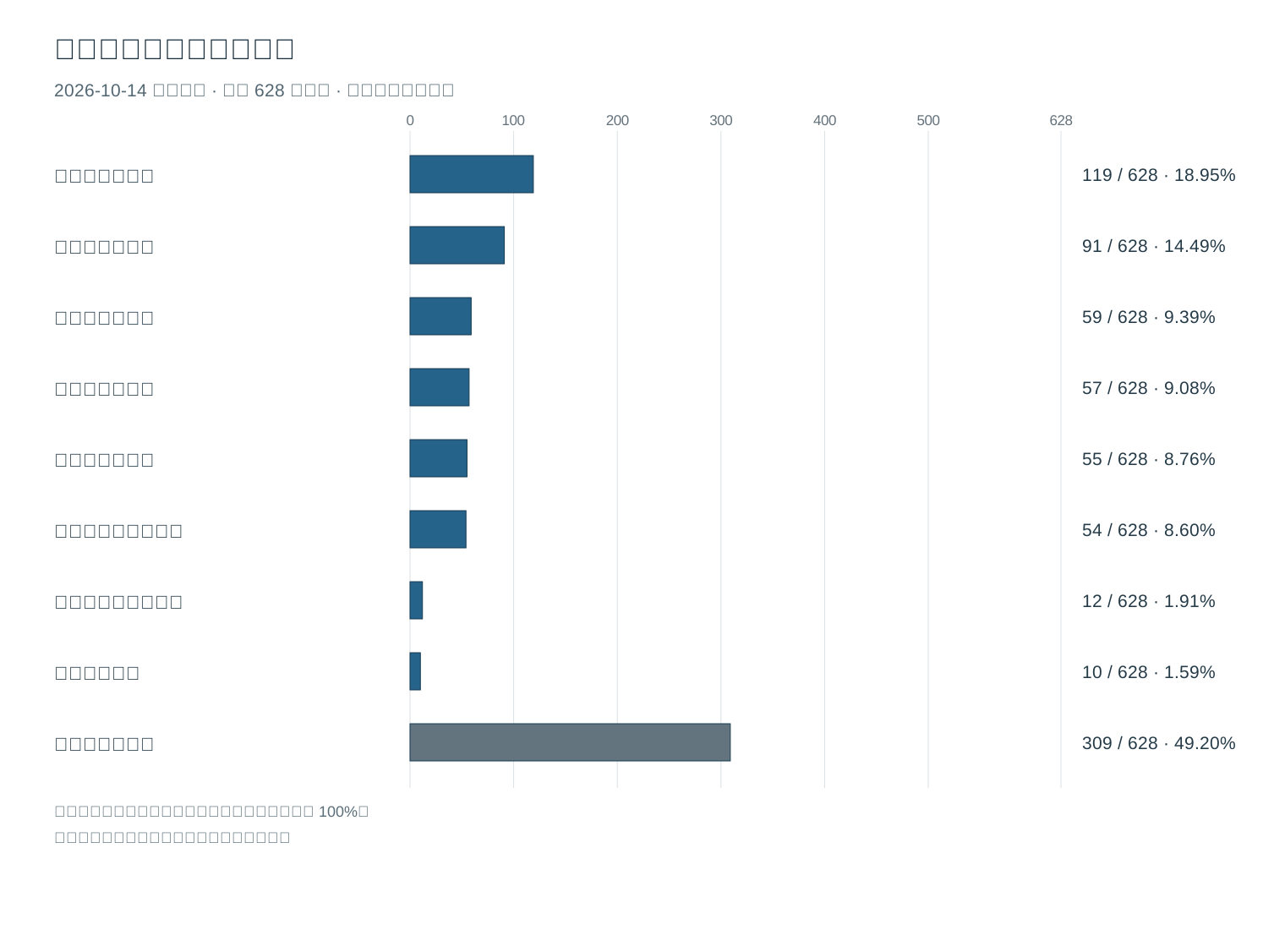
Product/promotion phrases match 119 records, the largest count under this codebook; graphic/title cues match 91. These are occurrences of predefined textual cues, not 119 validated product advertisements or a share of search-user demand. Every family uses all 628 records as its denominator rather than silently switching to identified-use records.
319 records match at least one family; 309 (49.20%) match none. Action-only descriptions, style-only descriptions, indirect intent, other languages and lexicon gaps can all contribute to unmatched records. They cannot be renamed one other-purpose category or declared purposeless. 96 records match multiple families, yielding 457 assignments. The eight shares total 72.77% here; that is not coverage and need not be filled to 100%.
The first rule pass counted phrases in a negative commercial comparison and prohibited phone/e-commerce interfaces as positive cues. We retain its codebook and summary, explicitly revise the rules to v1.1, then fully rerun with a bounded clause-negation filter and twelve boundary tests. Repairing known failures is not a semantic-classifier accuracy result; quotations, long-range negation and ambiguous intentions remain reviewable limitations.
| Text-cue family | Matching records | Denominator | Share and interpretation |
|---|---|---|---|
| Product / promotion cues | 119 | 628 | 18.95% · multiple labels allowed |
| Graphic / title cues | 91 | 628 | 14.49% · multiple labels allowed |
| Story / drama cues | 59 | 628 | 9.39% · multiple labels allowed |
| Interface / game cues | 57 | 628 | 9.08% · multiple labels allowed |
| Music / performance cues | 55 | 628 | 8.76% · multiple labels allowed |
| Documentary / lifestyle cues | 54 | 628 | 8.60% · multiple labels allowed |
| Instruction / process cues | 12 | 628 | 1.91% · multiple labels allowed |
| Character introduction cues | 10 | 628 | 1.59% · multiple labels allowed |
| No matching codebook cue | 309 | 628 | 49.20% · not no purpose |
03. 323 original modes are unreported; routing does not supply them
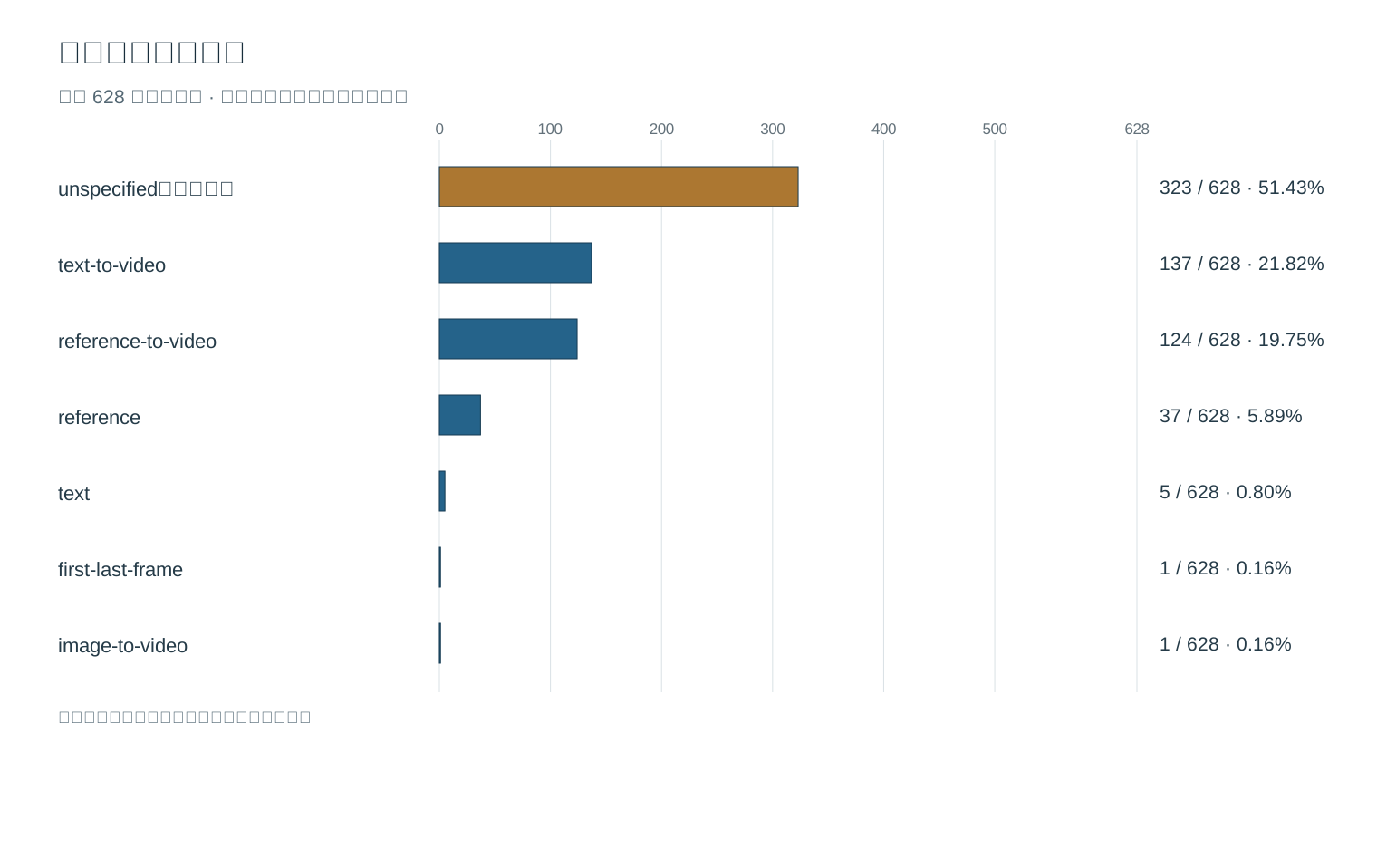
323 originalMode fields are unspecified (51.43%). Other values remain as written in the catalog: text-to-video, reference-to-video, reference, text, first-last-frame and image-to-video. We do not silently merge these aliases and call the result a provider-interface distribution. Even a populated metadata field does not disclose an accepted generation request.
The site-mapped mode field in the same frame labels 405 records text-to-video (64.49%). Yet 263 of the 323 original-mode unknowns are mapped to text-to-video and 60 to a reference workspace. A routing choice can help open a tool while the source field remains unknown; it does not create a missing observation.
There are zero duplicate groups under exact normalized prompt text and exact nonempty video URL in this snapshot, so both explicit sensitivity denominators stay 628. This zero applies only to those keys. It does not rule out similar wording, reuploads, reused edits or visually similar videos. No perceptual deduplication is performed, and similarity is not converted into independent quality experiments.
| Raw catalog originalMode | Records | Denominator | Share |
|---|---|---|---|
| unspecified | 323 | 628 | 51.43% |
| text-to-video | 137 | 628 | 21.82% |
| reference-to-video | 124 | 628 | 19.75% |
| reference | 37 | 628 | 5.89% |
| text | 5 | 628 | 0.80% |
| first-last-frame | 1 | 628 | 0.16% |
| image-to-video | 1 | 628 | 0.16% |
04. How to choose a public example as a reference
A cue match gives a place to begin a reference search. For a product clip, inspect the product images and their assigned roles; for a graphic or title clip, identify exact copy that needs post-production; for interface/game imagery, ask whether the material depicts a visual sequence or a working interface; for a process shot, check whether every intended stage has an input. The cue count does not settle these preparation questions.
A separate built-in-browser check inspected 28 actually displayed image samples across twelve purposively selected records. This small nonrandom selection is separate from the 628-row text denominator. Browser times identify sampled views, not exact cuts or decoded frame indices. An initial buffered seek in the telescope example is excluded. Audio was not listened to in any of the twelve records; no sound or success-rate conclusion follows.
For a reference worth reusing, retain the exact source, read the available inputs, identify the intended outcome and write down what remains unknown. The fixed source revision and hashes, versioned rules, per-record matches, unmatched list and rerun script make this study inspectable. Its catalog frequencies do not measure which task is popular, easy to reproduce or commercially effective.
For a case-level material check, see reference-input readiness. For a closer visual comparison of one example, see the laundromat information study. These are separate analyses with their own evidence scope.
| Observed contrast | Actually displayed samples | What this does not establish |
|---|---|---|
| Eyewear / poster / music-labelled clip | Telescope endpoint 15.104 s: eyewear portrait inside binocular mask; poster endpoint 10.144 s: pink cartoon poster and layered letter forms; music-labelled opening: face behind ONE LOOK text, endpoint black. | No exact-copy or audio/beat audit; a music cue in the prompt does not document a heard performance. |
| Website / game imagery | Shoe-focused webpage-like layouts at 0 and 15.104 s; dog, hearts/progress and directional-arrow imagery at 0 and 10.144 s. | No working website or interactive game was exercised. |
| Product / process imagery | Chair at 0 s, dark title card at 15.104 s; robot gripper and tabletop objects sampled at 0 and 6.592 s. | No comfort/ergonomic facts, complete pick-and-place sequence or physical accuracy established. |
| Three records whose originalMode is unspecified | Ice-cave endpoints 0/15.168 s; clay-workbench/vase endpoints 0/15.168 s; bed/sea-sunset endpoints 0/15.48771 s. | Visible imagery does not reveal accepted generation inputs or fill the three unknown modes. |
05. Original figures
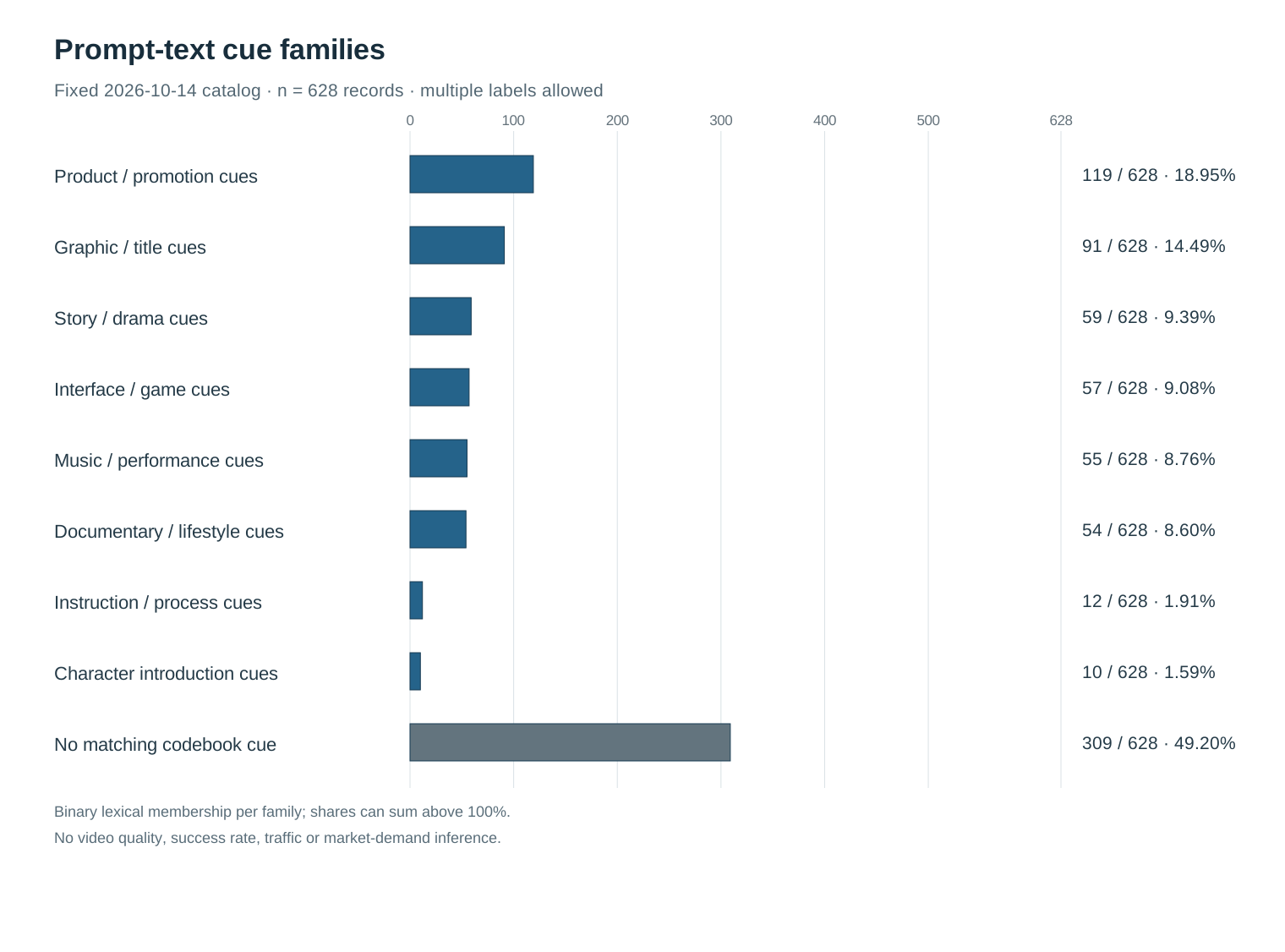
Final v1.1 prompt-text cues; denominator 628; multiple labels retained. Code-rendered statistical figure, not an AI cover.
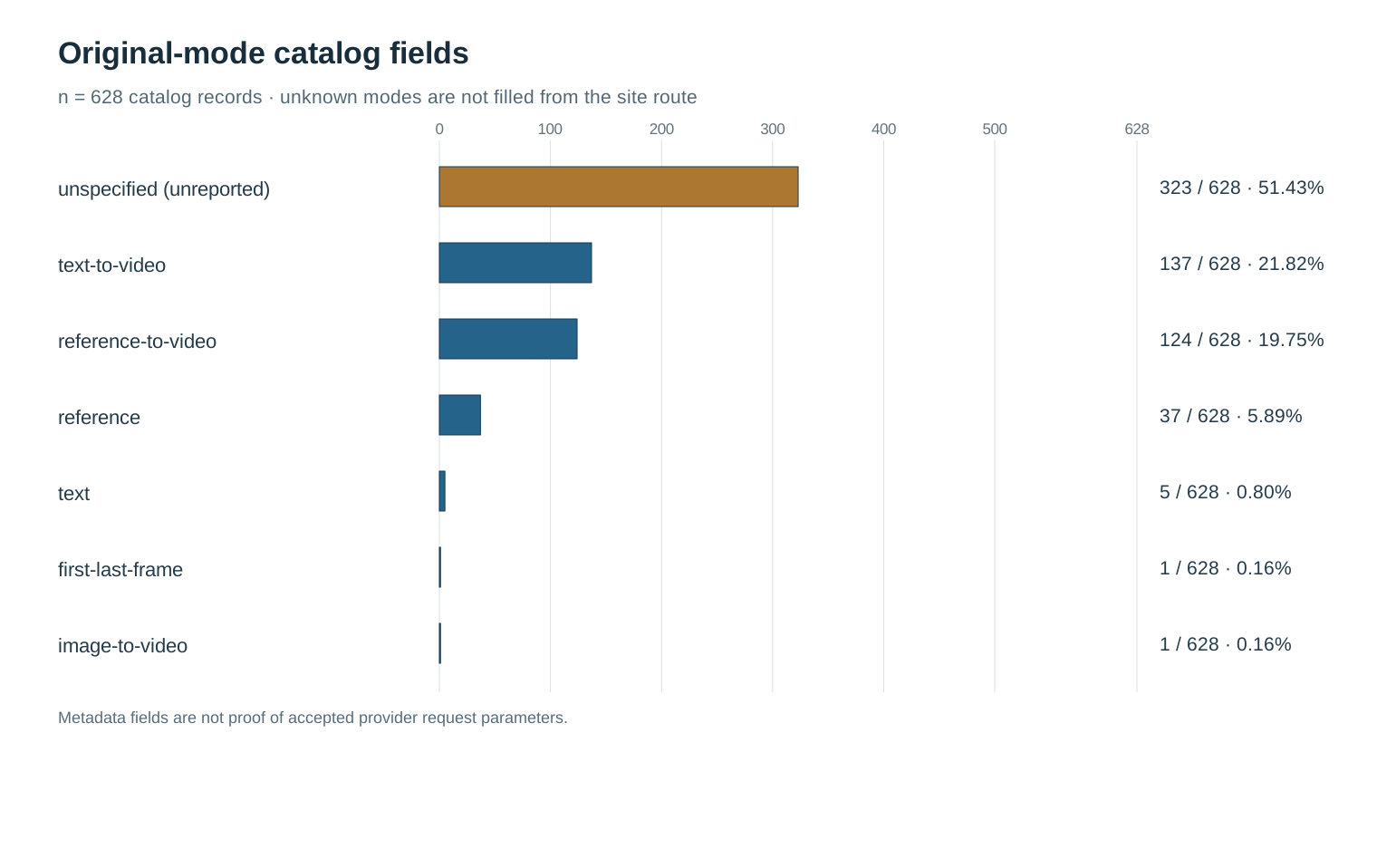
Raw originalMode catalog values; unknowns remain unknown.
06. Audit files and materials
- Derived-data, rules and synthetic-test kit; full input not included
- Final v1.1 statistics with denominators
- Eight purpose-cue counts
- Unfilled raw original-mode counts
- 628 row-level matches and hashes
- Detailed positive and suppressed matches
- 309 unmatched records, not purposeless records
- Explicit duplicate-key sensitivity denominators
- Exact duplicate-group result
- Per-record source attribution fields
- Final versioned English/Chinese codebook
- Known negation error and rule revision
- Sampling frame and data-quality limits
- Pinned source revision and hashes
- Reproducible standard-library study runner
- Twelve boundary tests
- Actual focused-test receipt
- Actual text-coding execution receipt
- Twelve purposive viewing requests
- English reproduction and scope notes
- Chinese reproduction and scope notes
- Original code-rendered cue chart (en)
- Original code-rendered mode chart (en)
- Original code-rendered cue chart (zh)
- Original code-rendered mode chart (zh)
- Actual independent rerun: 13 identical outputs
- SVG-to-PNG chart inspection receipt
- Actual browser samples: 12 records / 28 displayed images
- Case-level viewing observations and sampled times
- 28 internal screenshot hashes checked; no images redistributed
- Symbolic AI editorial cover provenance