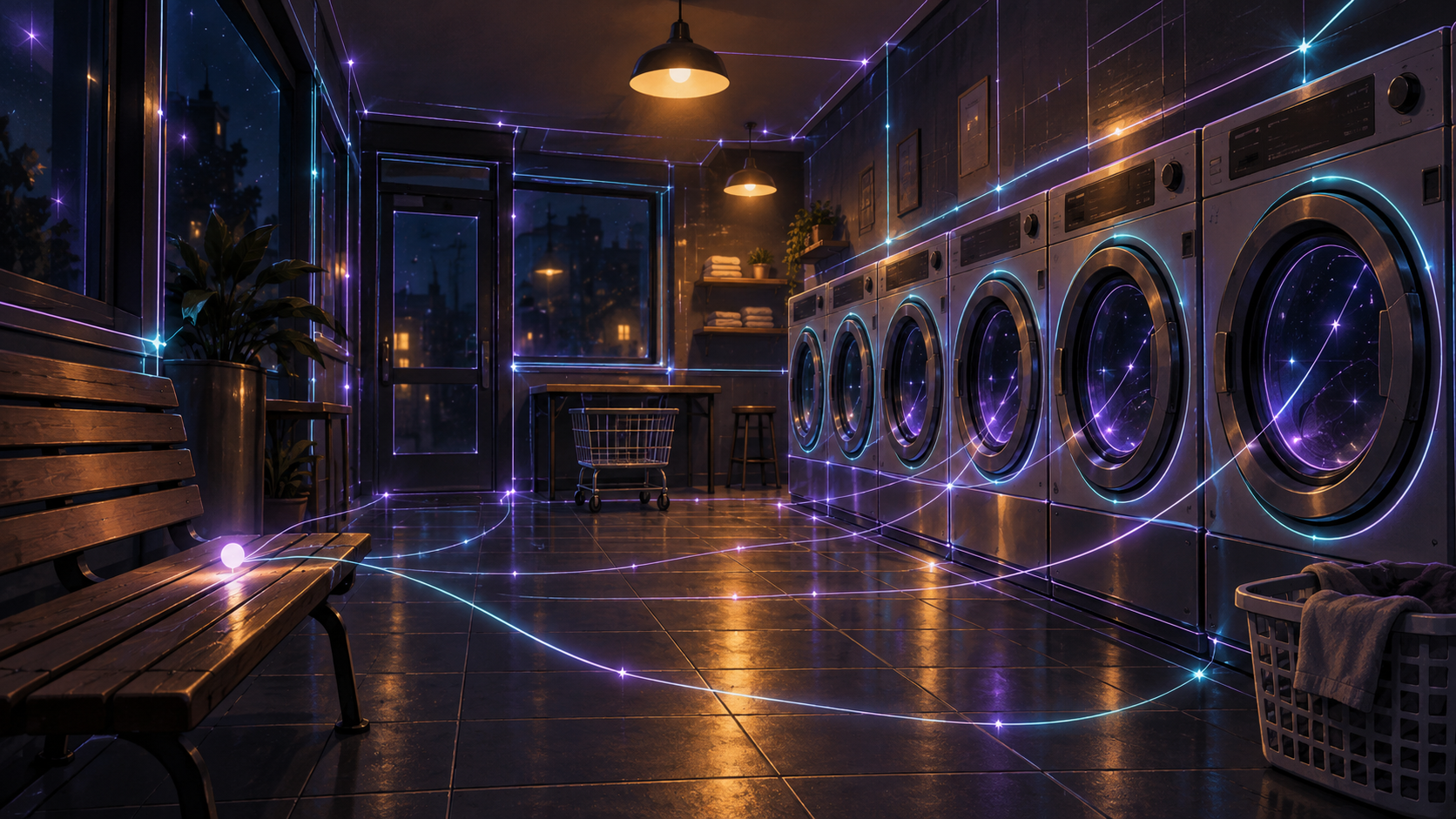
The cover is a symbolic editorial illustration made with the native image tool, not an H3 result or source-video frame. The original diagrams compare eight sampled visual observations.
Scope: Understand the example’s expansion of visual information without inventing a plot, audio treatment or a reproducible generation method.
01. The hand establishes a place to look; the opening object remains unnamed
The media element observed in the built-in browser reports 15.104 seconds at 1280×720. Eight paused samples were recorded through native controls and keyboard input. These currentTime values identify where the browser was sampled; they are not exact cut positions, decoded frame indices or a frame-by-frame account.
At 0 seconds, the visible foreground is fingers/a hand against a blurred laundromat. That sample does not establish a sock. At 2.11456 seconds, a purple jellyfish-like drawn form with a white outline is suspended above the hand. We can describe that visible relationship without naming an unseen starting object or assigning the hand a laundry chore.
My reading is that the nearby hand gives the graphic an easily located visual anchor. This is an editorial interpretation of the sampled arrangement. It is not evidence of the creator’s intended plot or a claim that the same composition continues throughout the opening.
| Browser sample (s) | Observed visual information | What remains unresolved |
|---|---|---|
| 0 | Foreground fingers/hand; blurred room | Opening object identity; no sock claim |
| 2.11456 | Purple, white-outlined jellyfish-like form above a hand | Movement between samples; cause of its appearance |
02. The motif changes form and context without proving a continuous transformation
The 4.07808-second sample has a central purple sock-shaped graphic with a cyan cuff; basket and floor details are visible behind it. At 6.0416 seconds, the view is close to a round washing-machine door: a hand meets the glass, and a purple fish-like graphic is near the fingertips. These are different observed forms in different contexts.
At 9.96864 seconds, a coin/vending-style panel and an opening are visible. A hand reaches toward the opening and a purple/cyan box-like drawing sits near the wrist. The panel’s precise function and the box’s contents are not verified. Calling this a purchase, a detergent handoff or a solved task would add information the observation does not supply.
The graphic color and drawn treatment offer a visual connection between these samples, while the adjacent hand and equipment make each form legible in a place. The sampled views do not establish a continuous jellyfish-to-sock-to-fish transformation, a single-shot camera path or a causal chain of physical events. The useful comparison is where the graphic sits and what the surrounding view lets us recognize.
| Sample (s) | Visible form | Local context | Analysis limit |
|---|---|---|---|
| 2.11456 | Purple jellyfish-like form; white outline | Above the hand | Appearance, not a biological identification |
| 4.07808 | Purple sock-shaped form; cyan cuff | Central, with basket/floor behind | No recovered physical sock |
| 6.0416 | Purple fish-like form | Fingertip area by washer glass | Inside/outside and causation unverified |
| 9.96864 | Purple/cyan box-like form | Wrist beside panel opening | Panel function and contents unverified |
03. The ending changes the scale of the information
At 12.08274 seconds, a wider room view shows purple/cyan linework across machines and the floor. Compared with the earlier hand-local samples, more of the space now carries the drawn layer. This is a comparison of coverage across sampled views, not a measurement of expansion speed or the exact moment a transition starts.
At 14.033572 seconds, room, machines, walls and ceiling lights have purple/cyan glowing outlines and star-like points. The media endpoint at 15.104 seconds still shows this room-encompassing treatment. That last sample supports a statement about the visible ending state, not how many frames or seconds it holds.
I read this as a spatial payoff: what first draws attention near a hand ultimately occupies the surrounding room. The change is in the scope of visual information, not a verified character arc. No observed sample establishes a completed washing task, a person’s departure or a narrative resolution beyond the room-scale visual endpoint.
| Sample (s) | Observed coverage | Supported editorial reading |
|---|---|---|
| 12.08274 | Machines/floor carry linework in a wide room view | Compare local detail with a wider field |
| 14.033572 | Room/machines/walls/ceiling lights outlined; star-like points | A room-encompassing state is visible near the end |
| 15.104 | Broad room treatment visible at media endpoint | Ending state observed; hold duration not measured |
04. What to borrow from this example, and what still needs evidence
For content design, this example suggests three questions: what does a viewer recognize first, which nearby context helps the next form make sense, and how much of the space should carry the final idea? Those questions can help assess a brief. They do not prescribe an H3 prompt or promise that a model will produce the same sequence.
The article’s diagrams intentionally use abstract labeled shapes instead of source screenshots. Their connections visualize our comparison of sampled moments, not measured cuts or a recreation of the source animation. Exact lettering and a branded ending, if needed in another project, should be planned as editable graphics rather than inferred from this example as proven model typography.
Audio was not listened to in this observation. No music, sound-effect, voice, beat alignment or sound-enhanced storytelling conclusion is made. This article therefore covers visual information only. The downloadable JSON and CSV separate visible observations, editorial interpretations and unresolved points so a later sound analysis can be added without rewriting uncertainty as fact.
The source catalog labels originalMode as text and lists no reference files. That provenance is useful, but it does not reveal the creator’s actual accepted request, settings, seed or rights clearance, and this site did not independently reproduce the video here. The defensible lesson is a progression from a local visual anchor to a broad spatial endpoint, bounded by the moments actually inspected.
To decide whether another source example has the inputs needed for your task, see the companion reference-input readiness audit. It checks named roles and missing files separately from this visual reading.
05. Original figures
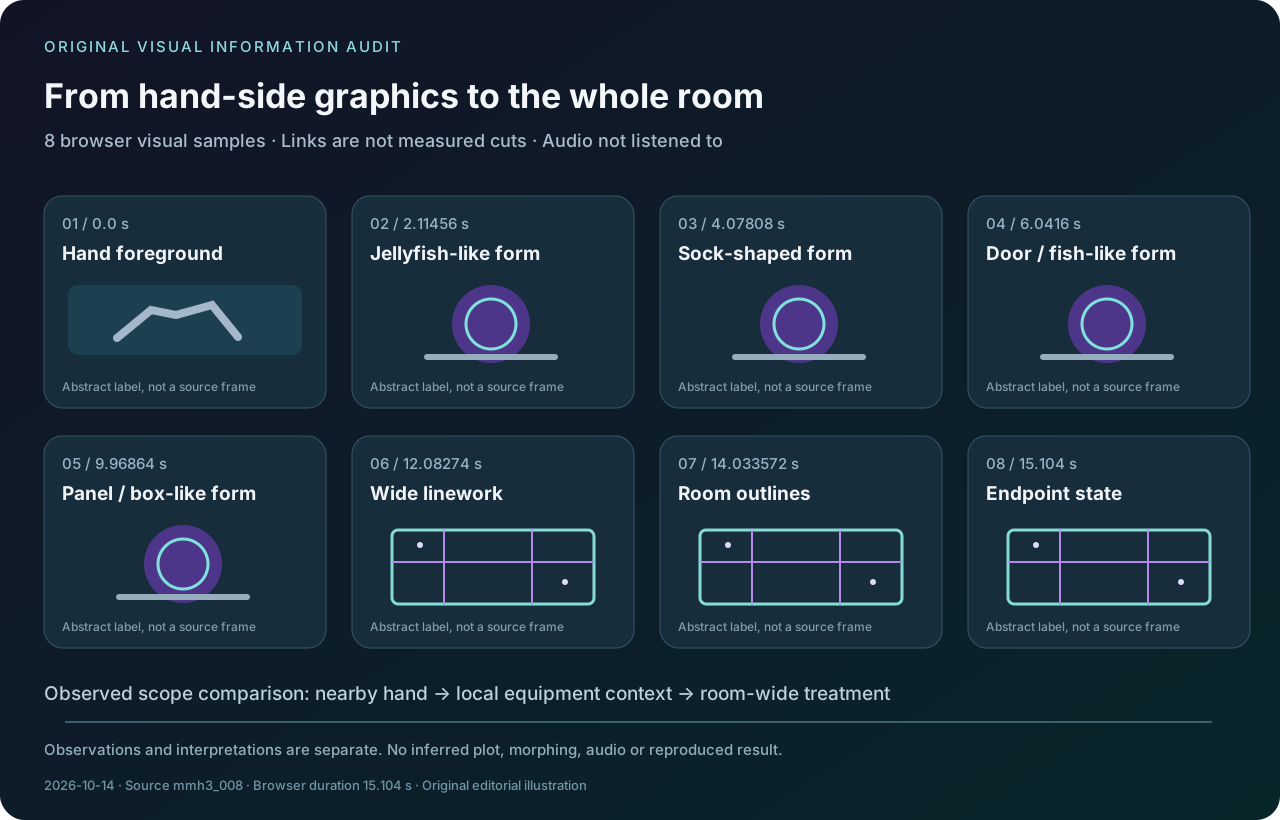
Original abstraction of eight sampled observations; connecting lines are comparisons, not measured cuts or source frames.
06. Audit files and materials
- Actual eight-sample visual observation with scope boundaries
- Eight observations, interpretations and unresolved points (CSV)
- Original English sampled-information diagram
- Original Chinese sampled-information diagram
- English method, provenance and reading guide
- Chinese method, provenance and reading guide
- Offline observation-table integrity checker
- Executed local metadata check; not a media or model test
- Complete original visual-information audit package
07. Sources
- Pinned Atlas catalog provenance for the laundromat source example
- Original Atlas-hosted source video (observed in the built-in browser)
- Existing Chinese source-example page
- Companion collection: judge reference-input completeness before choosing a task (not evidence of this video’s generation settings)