Transparent object and background: inspect a small camera-slide parallax
Keep an empty clear tumbler fixed while the camera slides slightly. Compare the background through the glass and outside it, along with rim and base continuity.
Describe a small viewpoint change through a stationary transparent object and inspect coherent background relationships. The original graphic source is an untested exercise, not an H3 optical benchmark or an exact refraction simulation.
This page presents an original method and illustrations. The prompt has not been independently tested with the generation model.
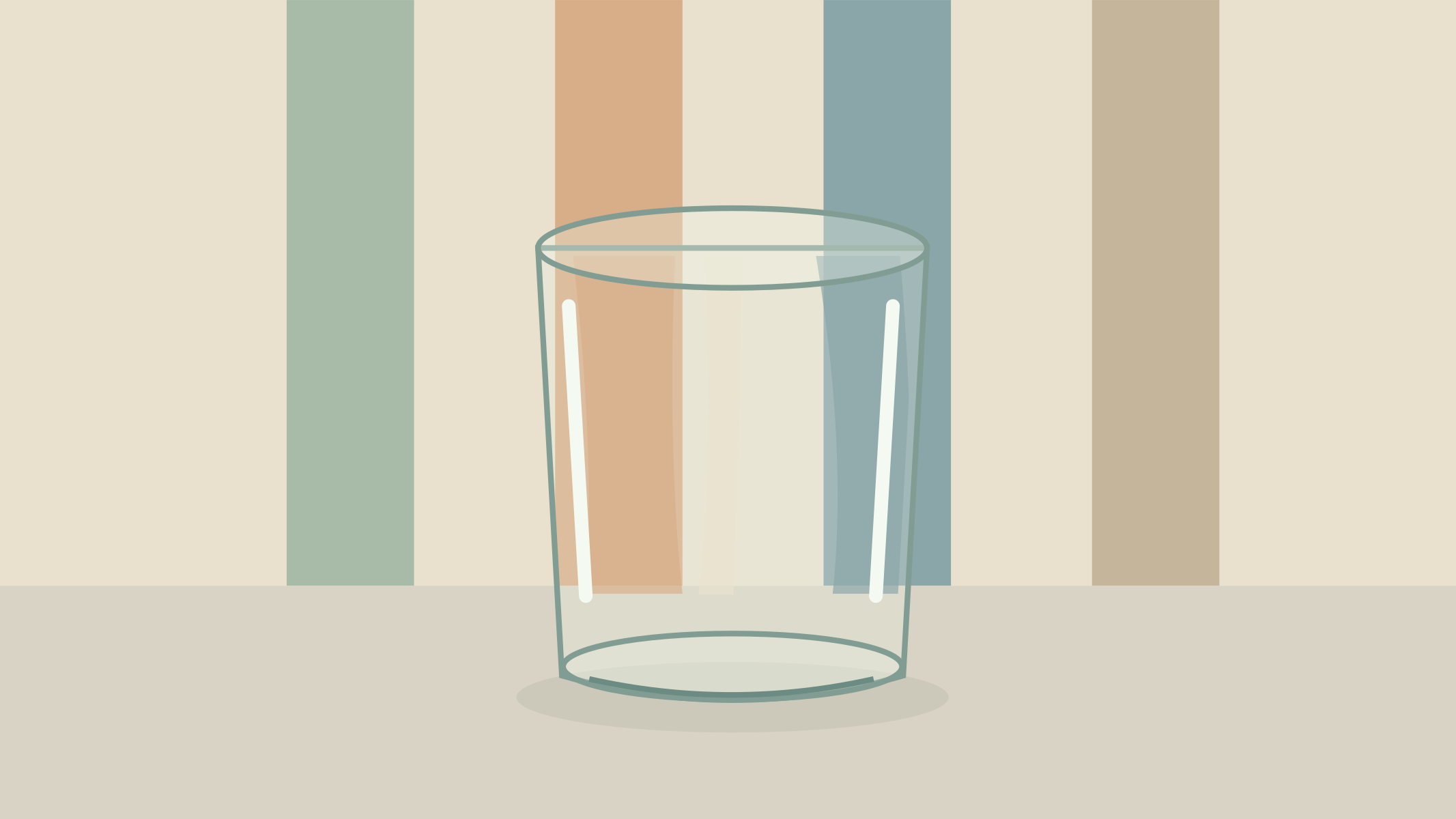
This page illustration explains the required composition; prepare your own authorized image with the relationships described below.
Prepare the input
- Prepare your own authorized image of one empty clear tumbler with an unobstructed rim, base and tabletop contact. Include broad vertical background bands behind it, with portions visible both through and beside the glass; omit liquid, logos and printed patterns.
- Place a simple background pattern at a visible distance behind the vessel. The original input uses broad vertical color bands rather than fine lines or text.
- Keep some of each band visible outside the glass as a comparison reference. Content through curved glass may be displaced or distorted; it should not be required to match the outside image pixel for pixel.
- Plan a tiny horizontal camera slide, preserving the table contact and vessel orientation. Large travel reveals unsupported rear geometry and makes distortion hard to separate from generated changes.
Open image-to-video and choose MiniMax H3. Enable Add end frame to expose First Frame, upload your prepared image there and leave Last Frame empty. Match the complete prompt below to the objects and colors in your image before submitting. Check the current controls and credit estimate; opening the workspace does not upload or submit a task. Keep annotated page diagrams out of the input slots.
The link carries the original page prompt; adapt it to your prepared image before submitting.
Prompt and procedure
Start from the uploaded empty clear tumbler in front of the broad vertical background bands. The tumbler remains fixed and upright on the tabletop. The camera slides slowly a very short distance to the right at the same height. The background bands shift coherently with the changing viewpoint, both outside the tumbler and as seen through its transparent walls; the view through the curved glass may be gently displaced and distorted but remains recognizable as the same background. Keep the rim, base and wall thickness coherent, with no liquid, frosted filling or new interior pattern. Stop the camera and hold. Fixed light, no glass rotation, no background animation, no text.
Establish the outside reference
Locate a broad band visible beside the vessel and another visible through its middle. Keep those identities in the brief; the source should support comparison without relying on a tiny printed label.
Move the camera alone
Ask for a tiny rightward translation at constant height. Keep tumbler and background stationary in the scene, so the viewpoint change is the sole reason their projected relationship changes.
Inspect the wall crossing
Follow one band as its visible region approaches a side wall. A displaced or distorted image through the glass is reasonable, but it should not become unrelated colored material painted inside the vessel.
Hold and compare rim/base
At the ending, inspect rim ellipse, lower edge and table contact as well as the background. If the glass becomes opaque or its outline deforms, reduce only the camera travel before adding lighting effects.
Check the result
Watch the complete actual result, then compare opening, middle and ending against each check below. In your own notes record the timestamp or frame, visible evidence, pass/fail/uncertain judgment and reason. Do not fill results from an illustration; an occluded or unreadable relationship remains uncertain.
- The empty tumbler stays upright with a continuous tabletop contact.
- The rim and base remain connected by coherent transparent side walls.
- The vessel does not turn, slide or acquire liquid.
- The same broad background bands remain identifiable outside and through the glass.
- Internal background movement stays coherent with the small viewpoint change, allowing curved-glass distortion.
- No frosted filling, painted inner pattern or unrelated scene appears inside the vessel.
- The ending holds after camera motion stops without band crawling or rim drift.
Troubleshooting and ending
The glass fills with an opaque color
Change only the material instruction to an empty transparent vessel with the same background visible through it; keep the small slide.
The bands inside move independently
Change only the background-role sentence to a stationary scene viewed through the walls; remove animated-pattern language.
The rim stretches during the slide
Reduce only the camera travel and compare the same rim ellipse and base again.
There is no readable parallax
Use a source with a clearer separation between vessel and background and broader bands; retain the tiny slide before increasing travel.
Finish with a still clear vessel and recognizable bands behind it. Save paired inside/outside crops and the rim/base check; report visual continuity without claiming exact optical reconstruction.
Related reading
- Small camera arc around a chair: trace all four floor contacts
- Character three-view reference: separate front, side and back files
- Cloud drift: hold the horizon and foreground still
- Curtain breeze: move the cloth, fix the window
- Desk lamp tilt: move one head around its visible joint
- Doorway push-in: stay within the visible space