One subject in a mirror: check the reflection and the glass boundary
Slide one bottle a short distance in front of a fixed mirror. Inspect paired motion, one reflected image and the mirror boundary without adding another physical bottle.
Request a short bottle slide with a corresponding mirror reflection and matched ending. The original illustration is a visual planning input; this method has not been tested on H3 and does not certify geometrically exact reflections.
This page presents an original method and illustrations. The prompt has not been independently tested with the generation model.
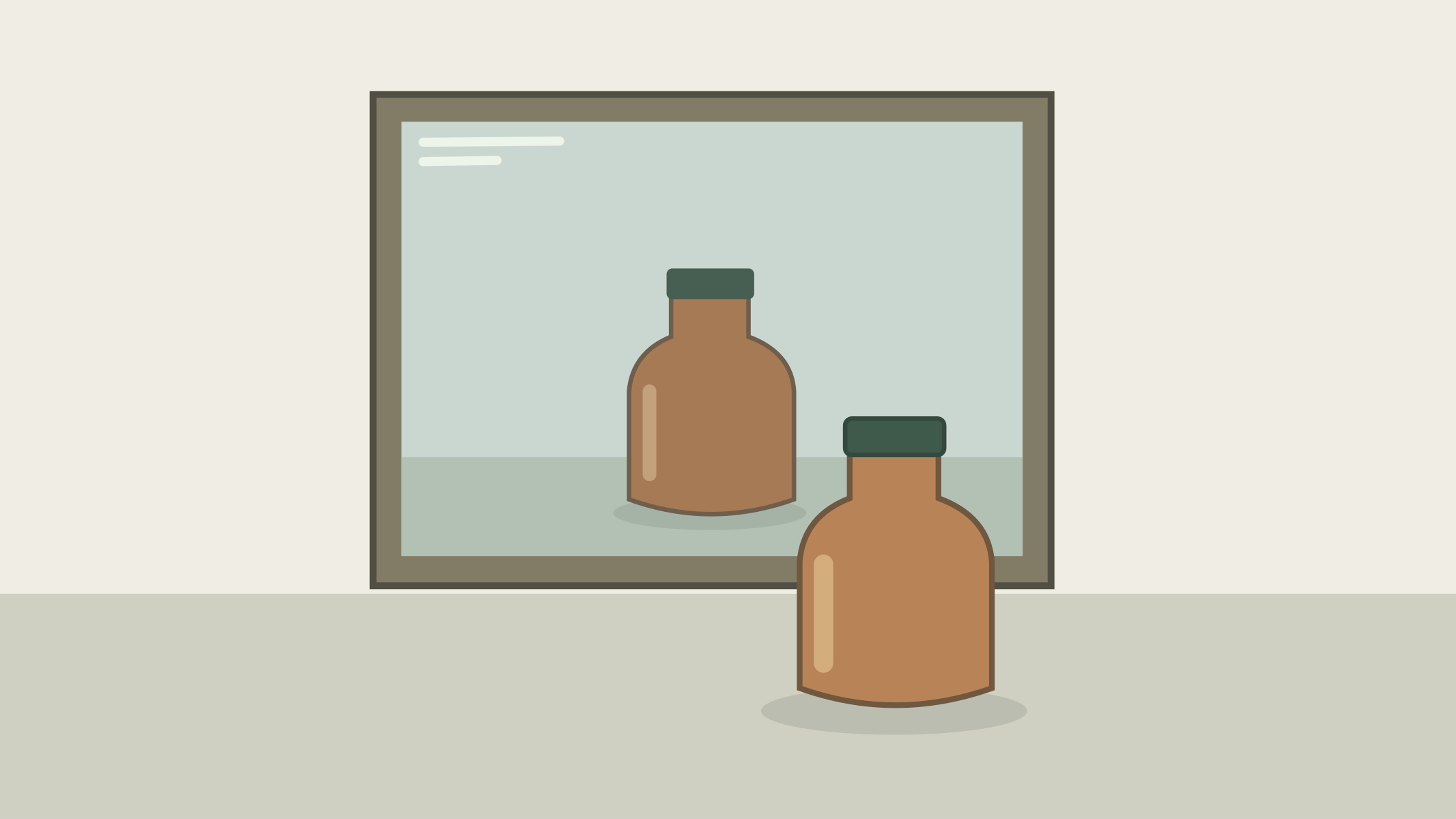
This page illustration explains the required composition; prepare your own authorized image with the relationships described below.
Prepare the input
- Prepare your own authorized image with one physical bottle, one readable reflection, the whole mirror frame and tabletop contact visible. Keep the object and reflection sufficiently separated to compare their silhouettes.
- Keep the object and reflected image visually separate. If they overlap heavily or the mirror edge is cropped, start with a clearer composition.
- Plan a short tabletop slide that keeps the reflection inside the mirror. Reflection geometry depends on the mirror plane and viewpoint; do not apply a blanket screen-left/screen-right inversion rule.
- For exact product reflectance or strict mirror geometry, use a controlled capture, compositing or a three-dimensional render. This task judges visible continuity and boundary behavior.
Open image-to-video and choose MiniMax H3. Enable Add end frame to expose First Frame, upload your prepared image there and leave Last Frame empty. Match the complete prompt below to the objects and colors in your image before submitting. Check the current controls and credit estimate; opening the workspace does not upload or submit a task. Keep annotated page diagrams out of the input slots.
The link carries the original page prompt; adapt it to your prepared image before submitting.
Prompt and procedure
Start from the uploaded scene with one physical bottle on the tabletop and its one reflection inside the framed mirror. The mirror, tabletop, camera and lighting stay fixed. The physical bottle slides slowly a short distance to the right while remaining upright and in contact with the table. Its corresponding reflected image moves coherently inside the mirror for the same action and stops when the bottle stops. Preserve the bottle silhouette, neck proportions and single cap in both views. Keep reflected content confined to the glass area without spilling across the frame or becoming an extra physical bottle. Finish with both views still. No camera move, no duplicate product, no changing mirror frame.
Separate object from reflected image
Count one physical bottle on the table and one image inside the mirror before running. Treat the reflected bottle as linked content, not a second actor with its own action.
Set a short paired action
Write one rightward slide with an upright bottle and a simultaneous reflected response. Keep the mirror and camera fixed so their movement cannot explain a drifting reflection.
Inspect the glass edges during motion
Check the reflection nearest the frame at mid-slide. It should stay confined to the glass; it must not paint over the frame, appear on the wall or continue as a physical bottle in front of the mirror.
Compare the two stopping states
Sample just before motion, during the slide and the final hold. Check shared start/stop timing and coherent cap/neck shape. If exact reflected geometry is required, move to capture or compositing rather than labeling a plausible view as verified.
Check the result
Watch the complete actual result, then compare opening, middle and ending against each check below. In your own notes record the timestamp or frame, visible evidence, pass/fail/uncertain judgment and reason. Do not fill results from an illustration; an occluded or unreadable relationship remains uncertain.
- There is one physical bottle and one corresponding reflected image.
- The mirror frame remains fixed and keeps its original shape.
- The physical bottle slides once while upright and supported by the table.
- The reflected image responds during the same action and holds when the bottle holds.
- Bottle silhouette, neck proportions and cap count remain coherent in both views.
- Reflected content stays inside the glass and never paints over the frame.
- No extra physical bottle appears outside the mirror during the final hold.
Troubleshooting and ending
A second physical bottle appears
Change only the role assignment to one bottle and its image confined to the glass; keep the short slide.
The reflection lags or keeps moving after the bottle
Change only the timing sentence to shared motion and stop; inspect the transition into the hold.
The reflection crosses over the frame
Reduce only the slide distance to preserve more space within the glass, then recheck the boundary.
The frame or camera moves to follow the bottle
Change only the fixed-role sentence to lock mirror frame and camera; keep bottle travel unchanged.
End with the upright bottle and its reflected image both still, each in the correct region of the scene. Record continuity and clipping results separately from any unresolved geometric accuracy.
Related reading
- Small camera arc around a chair: trace all four floor contacts
- Character three-view reference: separate front, side and back files
- Cloud drift: hold the horizon and foreground still
- Curtain breeze: move the cloth, fix the window
- Desk lamp tilt: move one head around its visible joint
- Doorway push-in: stay within the visible space