Hinged box opening: move the lid, hold the base in place
Describe a single lid-opening action with a stationary base.
Task and boundary
Describe a single lid-opening action with a stationary base. Use your prepared starting image and the written open-lid target to plan the shot; neither establishes a tested animation or mechanical simulation.
Prepare your own input
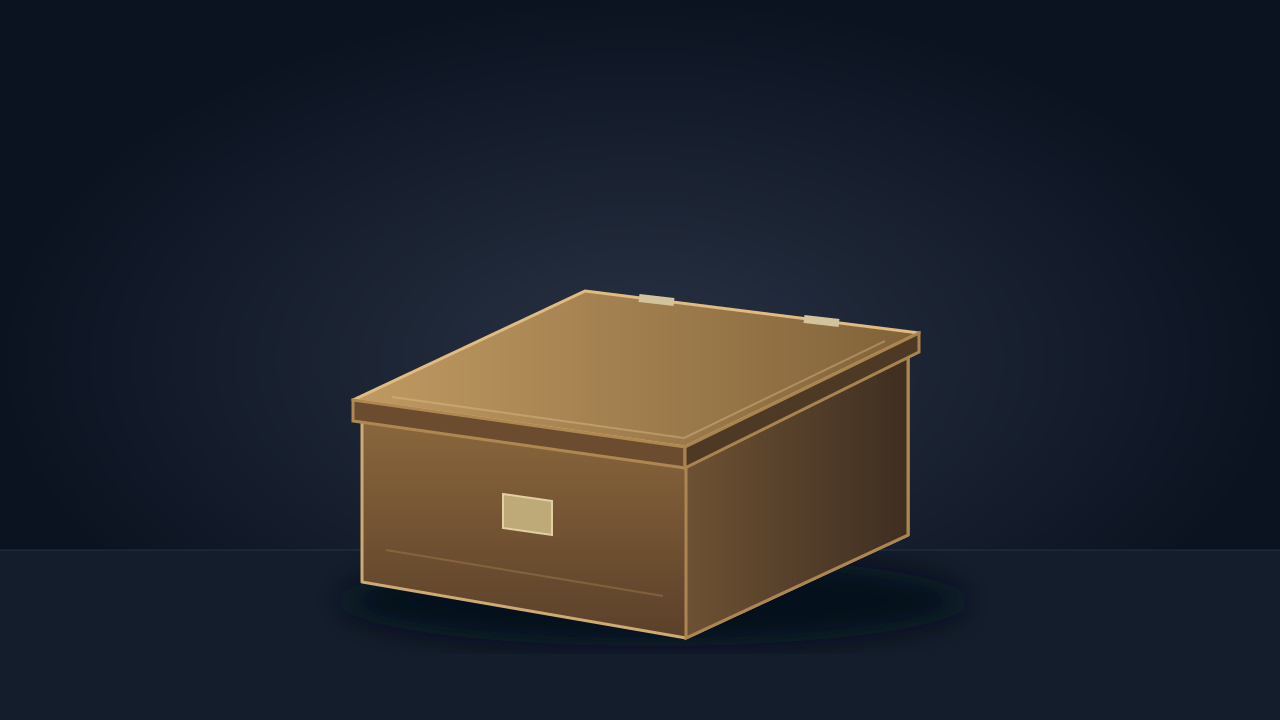
For an actual attempt, prepare a photo or drawing you own or have permission to use. Match the visible starting arrangement, contact gaps, fixed supports and identifying marks described below. Adapt the prompt’s object, color and style names to your image. If a necessary contact or movement space is missing, fix the input before submitting. The on-page illustration is a reading example; you can plan the action without running a generation.
- Use a first frame showing the base, lid and visible hinge side. Use your own authorized product image for an actual attempt; the on-page illustration explains the setup.
- Keep the box base in contact with a clear surface. Avoid cutting off the base corners, since they are your fixed-position checkpoints.
- Decide what the inside should contain before generating. If a real product interior must be exact, supply it through a supported workflow or capture it directly; a closed box does not reveal its hidden interior.
- Describe the intended ending in your own notes: the base remains on the table and the same lid is visibly open around its original hinge. Compare that written goal with the result. This single-image exercise needs only your starting image, without a second end-frame input.
Set up one image task
Use MiniMax H3 base image-to-video with your prepared image. If needed, enable Add end frame to expose First Frame, put only that image in First Frame and leave Last Frame empty. Check the actual available settings and current credit estimate before manual submission. The prompt is text you can copy; it does not upload your image or start a task. No exact duration, resolution, endpoint or successful result is guaranteed by these instructions.
Complete prompt
Start from your prepared, authorized image. Keep the box base fixed on the tabletop and keep the camera stationary. Only the lid opens slowly, turning upward around the back hinge line as one connected rigid piece. The base keeps its original size, orientation and contact with the table. The visible interior stays simple and empty. The lid reaches a clearly open position and pauses there without detaching or continuing to turn. No new contents, no camera movement, no added writing.
Operating sequence
1. Separate the three roles
Name the base as fixed, the lid as moving and the rear hinge line as the pivot. Describe one action, not an explosion of parts. Check that the input makes these relationships visible enough to judge.
2. Write the action and the stopping state
Request a slow opening and a pause in a clearly open position. Keep the camera stationary for the first attempt. Describe the intended open pose in words before the attempt; this does not establish an exact rotation angle or a guaranteed final frame.
3. Check the newly revealed area
Pause while the lid crosses the rim. Look for a moving hinge, a disappearing side wall or objects appearing inside. Compare what is visible in the output with what your input actually supplies, especially when using a photo of a closed package.
4. Correct the part that failed
If the base slides, revise its fixed-contact instruction while keeping the same action. If the hinge detaches, simplify the opening request. If the interior must reproduce a product exactly, switch to an input plan that contains that interior or use real footage instead of inventing details.
Inspect an actual result
For each criterion below, record the time or frame, visible observation and judgment in your own notes: pass, fail or inconclusive. Fill observed values only after inspecting an actual output; the intended ending is not evidence that the transition occurred.
- The visible base edges stay in the same positions relative to the tabletop.
- The lid moves as one part rather than folding, splitting or stretching.
- The hinge remains connected to the same rear edge of the base.
- The lid does not pass through the rim or erase a side wall during opening.
- No unexpected product or decoration appears inside the box.
- The action ends in an open pause instead of reopening, closing or rotating continuously.
- The result is judged as a visual opening sequence; it is not used as evidence of engineering tolerances or mechanically accurate motion.
Change one failure at a time
- The whole box lifts or slides Make the base-to-table contact the fixed role and remove words suggesting a reveal, lift or floating product. Retry the opening alone before adding camera motion.
- The lid becomes detached halfway through Describe one connected lid turning around the rear hinge line. Reduce the motion request and compare the same transition; more detailed hinge terminology may add objects instead of fixing the connection.
- Unexpected items appear inside State that the visible interior is simple and empty. For an exact real interior, change the source plan rather than repeatedly asking the model to guess what a closed box contains.
- The lid closes immediately after opening Put the open pause explicitly at the end of the action. Remove requests for a seamless loop if the required deliverable is an opening shot.
Ending and next step
Finish with the base still on the table and the lid visibly open. Keep your start image and written open-state target together; record whether the final clip passed the hinge and interior checks.
Related reading
- Glazed pottery: check the highlight and motif during a small camera shift
- knit unfold texture and hands
- MiniMax H3 page-turn prompt: animate blank pages and add exact text in editing
- Reflective bottle light sweep: keep the bottle still, move the highlight
- MiniMax H3 silent unboxing prompt: plan three beats as three simple shots
- steam over cup preserve mark