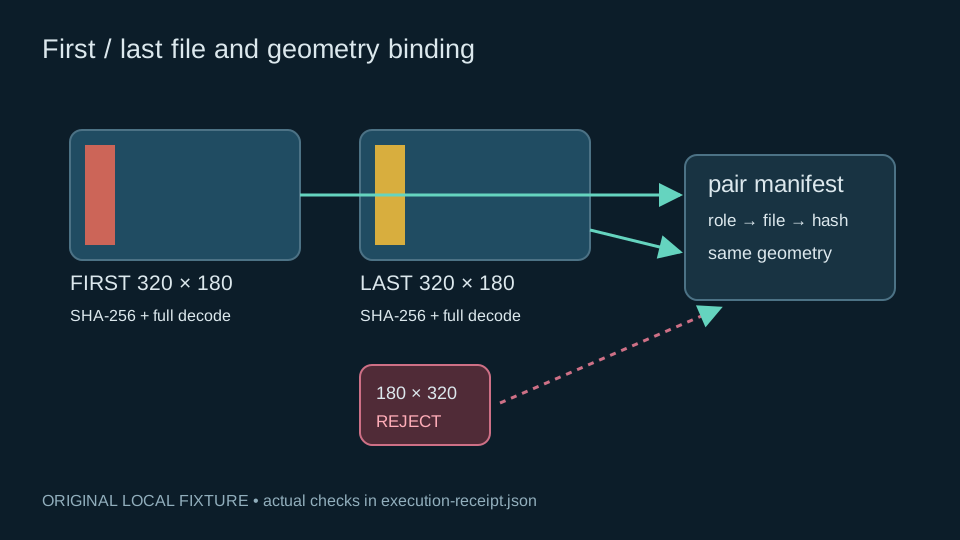
The tail image has the right subject but fails geometry.
Change only its actual pixel canvas to the pair’s selected dimensions, re-export, and capture a new hash. Renaming a portrait file cannot change its geometry.
Hands-on recipe
Prove that the files assigned to first and last are the intended readable images with matching geometry. This does not prove semantic continuity or a provider’s first/last-frame capability.
Includes executed local fixtures, scripts and receipts. These checks do not represent a video-generation service run.
node run-recipe.mjs --out ./my-run
The script creates a pair of small original RGB illustrations and writes a binding manifest. First and last have distinct bytes and edge markers. Hashes are captured from these exact files, not inferred from an upload order or a filename containing “first”.
For each bound file, read the PNG signature and IHDR width/height, then fully decode it through FFmpeg to one RGB frame. Both must be 320×180 and share the explicitly selected 16:9 canvas. Header dimensions alone would not establish that compressed pixels decode.
Run the portrait-last, swapped filename, missing last and parent-path cases. Each is expected to fail for its own reason: dimension mismatch, hash binding, missing input or unsafe basename. failure-receipt.json retains the actual exception messages.
Check seven passing assertions and the pre/post script hashes in execution-receipt.json. Keep both PNGs and binding.json together when adapting your own upload flow. Review camera, object and endpoint semantics separately; these file checks do not inspect them.
Change only its actual pixel canvas to the pair’s selected dimensions, re-export, and capture a new hash. Renaming a portrait file cannot change its geometry.
Correct the role-to-basename mapping, then regenerate both expected hashes from the selected files and recheck the manifest.
Replace only the damaged file with a complete local copy and rerun full decode. Do not accept IHDR dimensions as proof of readable pixels.
This pair manifest is a file-readiness record. It does not demonstrate a generated transition, endpoint compatibility or visual preservation between the two states.